Drones of War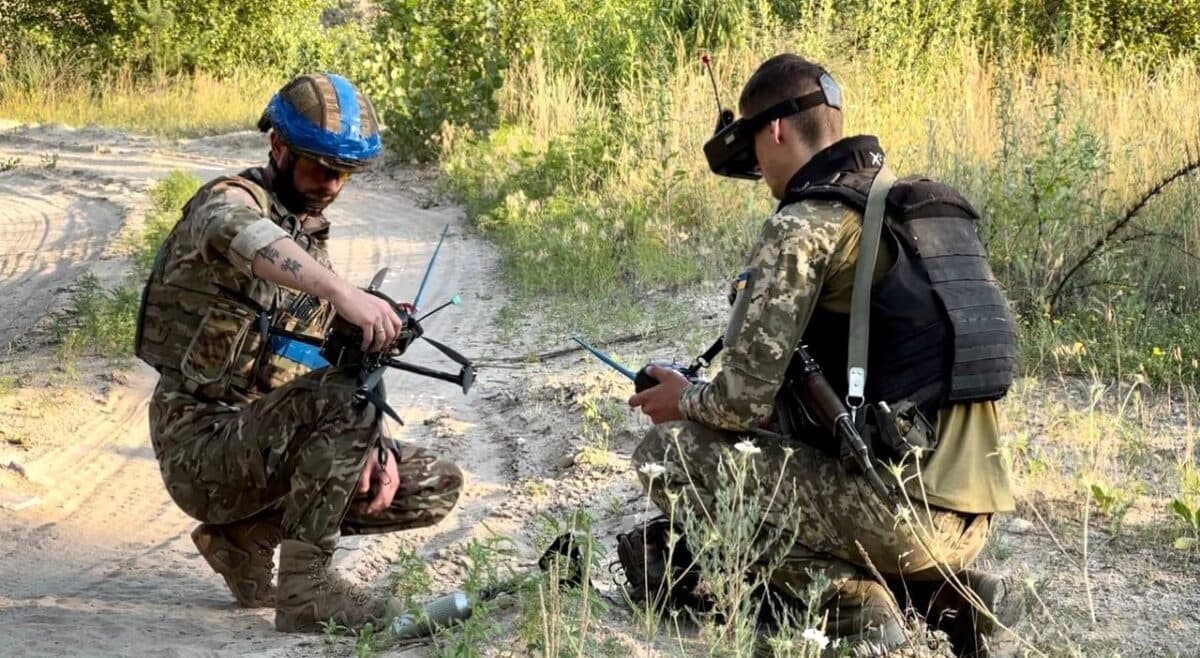
FPV Combat Drones
First-person-view racing drones, converted into precision kamikaze weapons for a few hundred dollars each, became the most prolific and arguably most important weapon system of the Ukraine war, produced by the hundreds of thousands on both sides.
The $500 Guided Munition
Here is the thing that should keep every defence planner awake at night: a teenager can build one of these in a garage. Carbon fibre frame, four brushless motors, a flight controller, a battery, a camera, and a pair of video goggles so the pilot sees what the drone sees. Strap on a 3D-printed tail adapter and a PG-7VL shaped charge pulled from a surplus RPG-7 round, and you have a guided munition with the accuracy of a sniper rifle and the punch to crack open a tank. Unit cost, all in, under $500.
That is not a theoretical scenario. By 2024, both Ukraine and Russia were churning these out at scales that put conventional precision munitions production to shame. Ukrainian officials cited targets of over one million FPV drones per year. Russian output, slower to ramp, reached comparable volumes. And these were not aspirational figures but operational ones. FPV strikes became a daily occurrence along the entire front, hitting main battle tanks, APCs, howitzers, logistics trucks, ammunition dumps, individual soldiers in trenches. Everything visible to a camera became a potential target for a $600 guided weapon flown by someone sitting in a basement a few kilometres back.
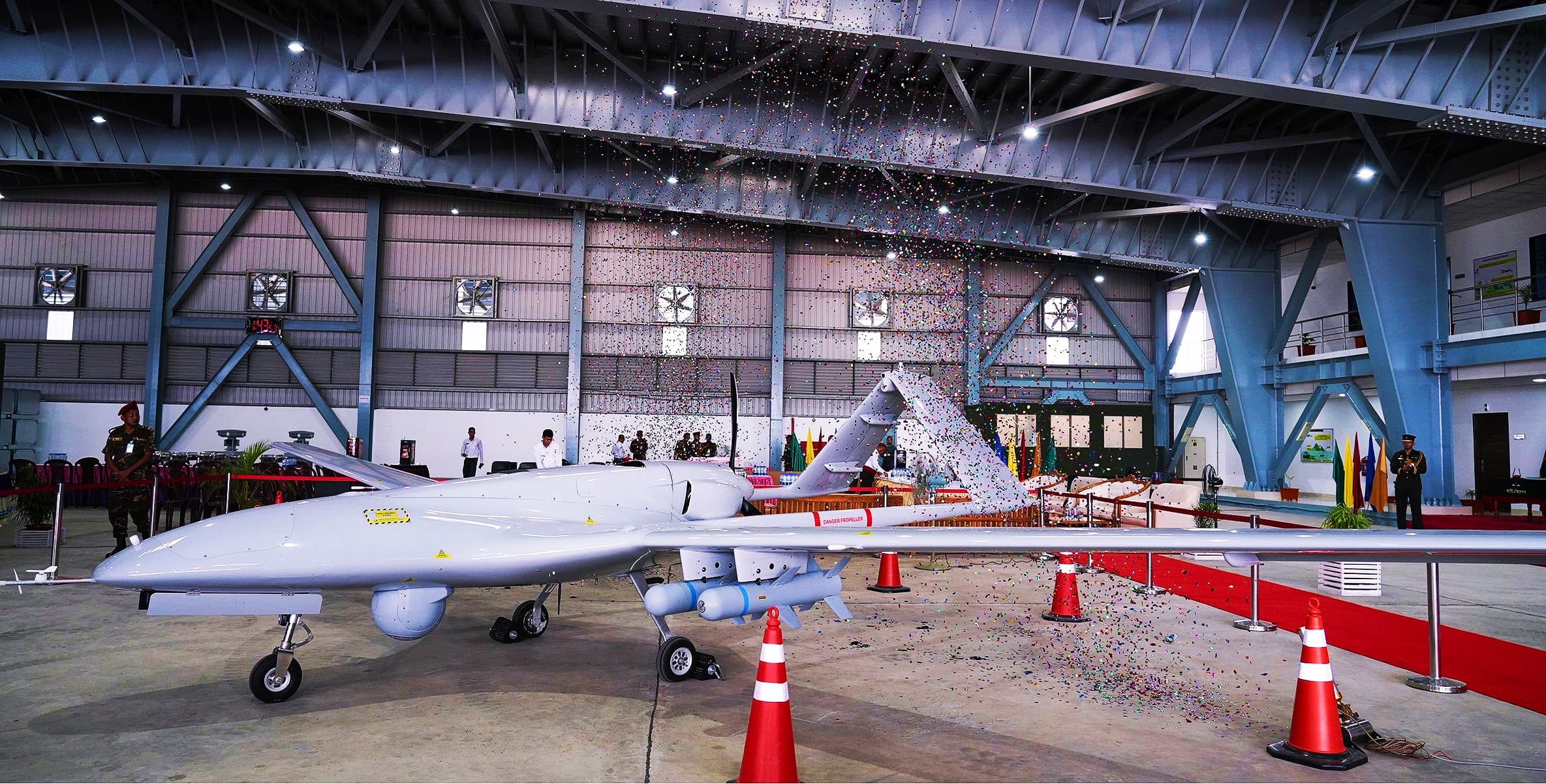
There is no single "FPV combat drone" the way there is a Bayraktar TB2 or an MQ-9 Reaper. It is a whole category: dozens of frame designs, hundreds of manufacturers, volunteer assembly networks, state procurement programmes, and constant battlefield improvisation. Collectively, it amounts to the most significant shift in small-unit lethality since the portable anti-tank missile showed up in the 1960s.
What a Typical Build Looks Like
Configurations vary wildly between units, manufacturers, and even individual operators, but the template is recognisable.
Most combat FPV drones run 7-inch propeller frames, which hit the sweet spot of payload capacity, speed, and manoeuvrability. The frame itself is carbon fibre, 200-400 grams bare. Five-inch frames show up for lighter payloads or close-quarters urban work. Ten-inch frames haul heavier warheads but trade away agility. Loaded up with a warhead and battery, the typical combat FPV weighs between 1 and 2 kilograms.
Propulsion is four brushless motors, usually 2806 or 2807 size on the 7-inch builds, spinning three-blade props. Depending on the build, top speeds sit in the 100-150 km/h range, with acceleration and directional changes fast enough that most targets simply cannot react in time. Flight time runs 10-20 minutes on a standard 6S LiPo, but combat sorties are far shorter than that. Fly to target, dive, impact.
The flight controller runs Betaflight or one of its forks, open-source firmware that handles stabilisation and attitude control. What makes precision diving attacks work is the responsiveness of that software, something the racing community spent years refining before anyone thought about strapping warheads to these things. The video link pushes a real-time camera feed to the pilot's goggles. Analog gives lower latency but grainier images. Digital systems like DJI's FPV platform, Walksnail, or HDZero deliver clearer pictures at a slight latency cost. That tradeoff matters when you are trying to identify and track a target in poor light or at the edge of your range.
The warhead deserves more attention than it usually gets, because the warhead is really what turns a racing toy into a weapon. The PG-7VL is the workhorse: a shaped charge from the RPG-7 system, capable of punching through roughly 500mm of rolled homogeneous armour. That is more than enough to go through the top armour of any main battle tank currently fielded. But operators have access to a whole menu. PG-7VR tandem charges deal with reactive armour. Improvised fragmentation payloads handle anti-personnel work. Thermobaric variants exist. Purpose-built shaped charges manufactured specifically for FPV mounting are increasingly common. The warhead sits on a 3D-printed or machined adapter bolted to the frame, with a piezoelectric fuze that fires on impact.
Pilot Skill Is the Real Bottleneck
This is the part that gets underappreciated in most discussions of FPV warfare, and it is where the weapon differs most from the precision munitions it gets compared to. An FPV strike drone has no autonomous terminal guidance. The pilot flies it all the way in. Through the camera feed, at speeds exceeding 100 km/h, navigating terrain, dodging obstacles, tracking a target that may be moving, and executing a terminal dive. All of it in real-time, often through a video feed degraded by interference or range.
That makes FPV piloting one of the most skill-intensive combat roles in the entire conflict. Effective operators need hundreds of hours of simulator time followed by live flight practice before anyone trusts them with a real combat sortie. The best pilots can put a drone through a vehicle hatch, into a trench opening, or through a window from a kilometre out. Novice pilots miss more often than they hit. At $400 for the drone plus another $200 for the warhead, those misses add up.
Both sides built dedicated training pipelines. Ukraine stood up formal FPV pilot schools, drawing heavily on the civilian drone racing community, which turned out to be a surprisingly deep talent pool. Russia, initially behind the curve, scaled its own training apparatus through military units and volunteer organisations. On both sides, demand for trained FPV pilots outstrips supply. That shortage matters at least as much as the drone supply itself, and possibly more. You can build drones faster than you can train the people to fly them well.
Three Supply Chains Running in Parallel
The production story is genuinely unusual because it does not look like military procurement in any conventional sense.
The first track was volunteer and crowdfunded. In the early phases of the war, networks built around the civilian FPV racing community sourced commercial components, assembled drones in workshops, and shipped them straight to front-line units. Social media crowdfunding campaigns pulled in millions of dollars. Fast, decentralised, and effective at scaling quickly, but quality was inconsistent and coordination was limited.
Then the states got involved. Both Ukraine and Russia institutionalised production through government contracts and directed manufacturing. Ukraine's Ministry of Digital Transformation and Ministry of Defence set up procurement frameworks, established component and performance standards, and contracted dozens of small manufacturers. Russia took a parallel path, routing production through defence enterprises and volunteer organisations like the People's Front.
The third track never went away and probably never will: front-line fabrication. Units assemble drones from shipped components, cannibalise damaged ones for parts, and maintain their own repair capabilities right behind the line. This is where tactical flexibility lives. A unit can configure drones for specific missions, test a new warhead design, or adapt to local EW conditions faster than any centralised system could ever manage.
The combined output is staggering. Ukrainian officials reported over 1 million FPV drones produced in the first ten months of 2024, exceeding the original annual target, with total 2024 output reaching roughly 1.5 million. Run the cost arithmetic: $300-$500 per drone, $100-$200 for the warhead. The entire annual FPV production programme costs less than a squadron of fighter jets.
Fiber-Optic Links and AI Guidance
Two developments are outpacing countermeasures faster than the defence side can adapt, and they are worth understanding in some detail because they change the calculus considerably.
Fiber-optic FPV solves the biggest vulnerability of the standard design. A conventional FPV drone transmits video and receives commands over radio frequency. That RF link is what electronic warfare targets. Jam the frequency, and the pilot goes blind or loses control. The fix is almost absurdly simple in concept: trail a hair-thin fiber-optic cable behind the drone as it flies, running video and control through the wire instead of over the air. A fiber-optic FPV drone is flat-out immune to RF jamming. The wire weighs a few grams per kilometre and snaps on impact, leaving nothing to recover. Both sides had fiber-optic variants in the field by 2024, and the technology spread fast through 2025. The execution, for the record, is harder than the concept. Spooling and tension management at flight speeds is a genuine engineering challenge. But it works.
AI-assisted targeting is the bigger deal. A trained neural network identifies and tracks targets in the camera feed: vehicles, personnel, equipment. The pilot flies the drone to the general area, designates a target on-screen, and the AI handles the terminal dive, adjusting flight path to hit the designated point even if the video link drops in the final seconds. That last detail is critical. The most effective countermeasure against standard FPV drones is jamming the video link during the terminal phase, right when precision matters most. AI terminal guidance makes that countermeasure irrelevant. It also lowers the skill floor for effective operators, which matters a lot given the pilot shortage on both sides. Multiple Ukrainian and Russian companies have working systems, and deployment is accelerating. I would not be surprised if AI-assisted becomes the default configuration within a year or two.
The EW Arms Race
You cannot talk about FPV drones without talking about electronic warfare. They are two sides of the same fight.
Broadband and targeted jammers try to overwhelm the video downlink and control uplink frequencies. When jamming works, the pilot either goes blind (loses the video feed) or loses control entirely (the drone drops into failsafe, typically hovering or flying to a preset return point, neither of which involves hitting the target). Both sides have vehicle-mounted, fixed-position, and portable jammers deployed along the front. In some sectors, the EW coverage is dense enough that standard FPV drones simply cannot operate.
The counter is what you would expect: frequency-hopping spread-spectrum radios, higher transmit power, directional antennas, and the fiber-optic links described above. What makes this arms race unusual is the speed. A new jamming technique deployed in one sector triggers a firmware update to FPV radios within weeks, not months. Front-line feedback loops, not formal acquisition programmes, drive the cycle.
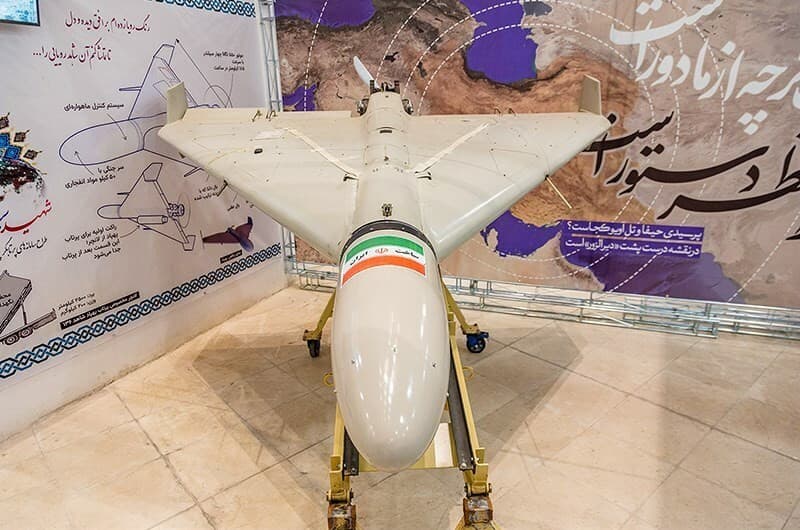
GPS denial is a factor but a lesser one. Some EW systems target GPS signals that certain FPV drones use for navigation or return-to-home functions. Since most combat FPV relies on pilot skill rather than GPS, the effect is limited compared to what GPS denial does to platforms like the Geran-2. But it complicates things for AI-assisted variants that use GPS for position estimation, which is worth watching as those systems proliferate.
The Exchange Ratios Are Brutal
A $400 drone with a $200 warhead can kill a $3-10 million main battle tank. Or a $1-3 million APC. Or a $3-5 million self-propelled howitzer. Or a $50,000-$200,000 logistics truck. Or an ammunition dump worth millions. Or the crew of a weapon position, which has no dollar figure.
Even assuming hit rates well below 50 percent (early operations reportedly ran 20-40 percent, improving as pilot training matured), the exchange ratio is overwhelmingly in the attacker's favour. This is probably the single most important takeaway from the Ukraine war for military planners worldwide: precision strike capability that used to require million-dollar missile systems is now available for the price of a decent laptop.
Hard Lessons from the Front
A few things became clear that were not obvious before Ukraine put them to the test.
FPV drones are not optional. By 2024, FPV strikes accounted for a significant share of equipment kills on both sides. Any force operating in a contested ground environment without its own FPV capability, both offensive and for detecting inbound drones, faces a devastating gap. Units without drone coverage suffered disproportionate casualties. This is not a nice-to-have. It is table stakes.
Defence requires depth. No single countermeasure works. Effective FPV defence means EW jamming combined with physical obscurants (smoke, cam nets), point-defence weapons (shotguns, vehicle-mounted anti-drone systems), dispersal, and above all tactical discipline. Forces that cluster, move predictably, or neglect overhead cover get destroyed. It is a layered problem demanding a layered answer.
Supply chains outweigh design. The technology is mature and cheap. The constraint is not building a better drone; it is producing, shipping, and maintaining drones and trained pilots at the rate the battlefield eats them. Both sides poured resources into supply chain capacity, and the side that can produce more drones faster holds a structural advantage that compounds over time. This is an industrial competition as much as a technological one.
The skill ceiling is high and it matters. Basic FPV operation is learnable in weeks. Combat effectiveness takes months. The best operators produce dramatically better results than average ones. Investing in pilot quality rather than just drone quantity pays outsized returns, and both sides learned this the expensive way.
Where FPV Falls Short
They are not a wonder weapon, and the limitations are operationally real.
Range caps out at 5-15 kilometres for standard variants, which locks FPV drones into the tactical close fight. They cannot reach deep targets, interdict supply routes at distance, or substitute for longer-range strike. The pilot has to be close enough to maintain the video link, which puts the operator within counter-battery range and vulnerable to direct attack.
Weather hits hard. Wind makes precision dives difficult. Rain shorts electronics. Cold eats battery capacity. Winter operations in Ukraine reportedly saw noticeably reduced FPV activity during the worst weather periods. This is not a weapon that works equally well year-round.
Expendability is baked in. Every drone is destroyed on use. Sustained operations demand continuous production and resupply. A unit that runs dry on drones or pilots loses its most effective precision tool overnight, and there is no way to stockpile your way out of that dependency.
Then there are the harder questions. The ease with which an FPV drone can target an individual soldier, a guided munition flown by an operator kilometres away killing someone visible to a camera, raises genuine issues around proportionality and the human cost of cheap precision strike. Those questions will not be resolved by this conflict. They are just getting started.
What Comes After Ukraine
The FPV combat drone is the most broadly accessible precision weapon in the history of warfare. It needs no defence industrial base to manufacture, no formal military training pipeline to learn, no launch infrastructure to deploy, and no expensive logistics tail to sustain. A motivated non-state group with access to online parts suppliers and a 3D printer can field strike capability within months.
That reality is already reshaping conflicts beyond Ukraine. FPV combat drones have turned up in Myanmar, Sudan, and other active conflict zones. The question is not whether they will spread further. They will. The question is whether established militaries can adapt their doctrine, training, procurement, and force protection fast enough to operate in a world where precision strike from the air costs $500 and is available to anyone willing to learn.
Sponsored
Place your ad hereSpecifications
| Typical Frame Size | 7-10 inch |
| Weight | 0.5-2 kg (varies by payload) |
| Warhead | RPG warhead (PG-7VL), shaped charges, or improvised munitions |
| Max Speed | 100-150 km/h |
| Range | 5-15 km (radio link dependent) |
| Flight Time | 10-20 minutes |
| Cost | $300-$500 per unit (approximate) |
| Guidance | First-person view (FPV) goggles, analog or digital video link |
| Propulsion | Electric (brushless motors, LiPo battery) |
| Variants | Standard RF, fiber-optic (jam-proof), AI-assisted terminal |