Drones of War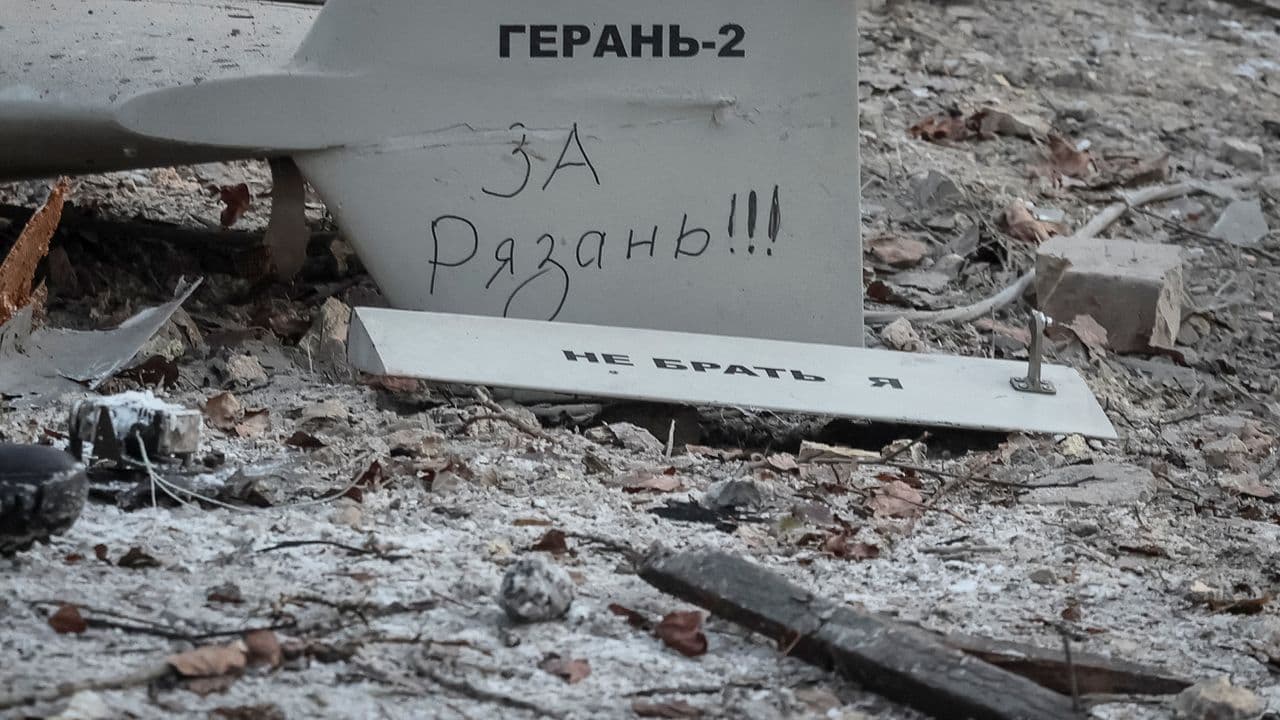
Geran-2
The Geran-2 is Russia's locally manufactured version of Iran's Shahed-136 one-way attack drone, produced in the thousands at the Alabuga factory and deployed relentlessly against Ukrainian infrastructure in the largest drone campaign in military history.
The $30,000 Bomber
Here's the number that should keep every defence planner awake at night: according to CSIS analysis of Ukrainian Air Force data, Russia launched over 14,700 one-way attack drones between September 2022 and the end of 2024, with the majority coming in 2024 alone as attacks escalated from around 200 per week to over 1,000 per week by late autumn. Assume an interception rate around 85 percent. That means well over a thousand got through to their targets every year. At an estimated $20,000-$50,000 per drone, Russia sustained an entire strategic bombardment campaign for roughly the price of a single modern warship.
That cost equation is the whole point of the Geran-2. Not its warhead. Not its guidance. Not its speed, which is genuinely slow (we'll get to that). The point is that it exists in thousands, costs almost nothing by military standards, and forces the defender into a spending trap where every interception costs ten to twenty times what the drone itself cost to build.
But before the economics, there's the question of where this thing actually came from.
Iranian Roots, Russian Scale
The Geran-2 started its life as the Shahed-136. Officially, Russia denies any Iranian origin. Iran denied supplying the drones at all until the evidence became impossible to wave away. Wreckage analysis, intelligence reports, and eventually Tehran's tacit acknowledgement told the real story: Iran provided Russia with complete Shahed-136 kits, technical assistance, and finally a full technology transfer package for domestic production. Russia stamped a new designation on it and called it the Geran-2.
Calling it a "Russian Shahed-136" doesn't quite capture what happened next, though. What began as kit assembly turned into genuine domestic manufacturing with Russian modifications. Different navigation systems. Different engine variants. Different component sourcing. And a production scale that outstripped Iran's own capacity.
(If you want the original Shahed-136 story, its Iranian development, the Houthi deployments, the design philosophy behind it, that's covered in our Shahed-136 entry. This piece is about what Russia did with the design once they had it.)
The centre of that production effort is the Alabuga Special Economic Zone in Tatarstan, about 1,000 kilometres east of Moscow. Satellite imagery and intelligence reporting tracked the construction of a purpose-built drone factory there starting in late 2022, with output ramping through 2023 and 2024. The plans were ambitious from the beginning: assembly-line manufacturing of several thousand units per year. Workers, reportedly including conscripted labour and foreign recruits brought in under murky circumstances, built drones from a mix of domestic components and parts funnelled through sanctions evasion networks.
Early on, production depended heavily on Iranian-supplied kits, complete airframes, engines, guidance components shipped in for final assembly. That dependency decreased over time as Russia substituted parts into the supply chain. By mid-2024, the Alabuga factory alone had produced over 6,000 Geran-2 units under a $1.75 billion franchise agreement with Iran, exceeding its initial contract ahead of schedule, with production rates still climbing. The thousands of individual Geran-type drones that the Ukrainian Air Force reported intercepting through 2023 and 2024 give a rough lower bound on how many were actually launched.
What It Actually Is (and Isn't)
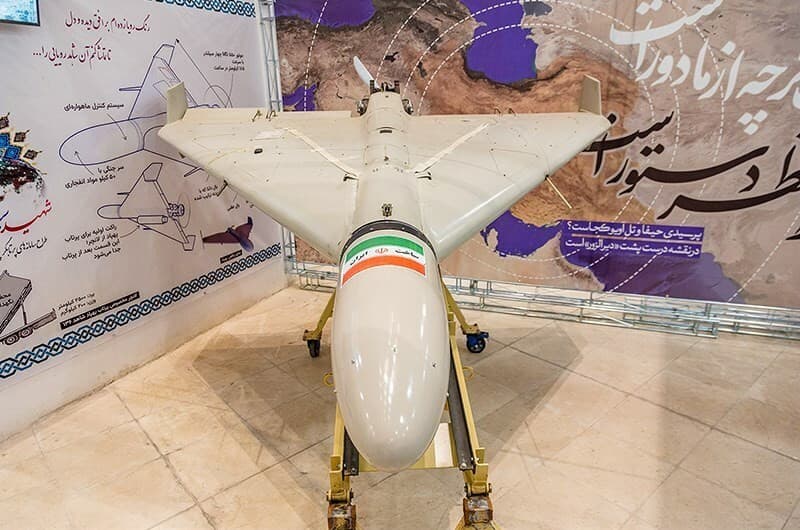
The basic design stays close to the Shahed-136: a delta-wing flying wing, a small piston engine driving a pusher propeller at the rear, warhead in the nose, launched from a rack or truck-mounted rail. It's a one-way attack drone. The Western label "loitering munition" is a loose fit since the Geran-2 doesn't really loiter. It flies a pre-programmed route to a fixed set of coordinates and detonates when it arrives.
The airframe is about what you'd expect from something designed to be stamped out in quantity. Delta-wing planform spanning roughly 2.5 metres, fuselage about 3.5 metres long. Composite materials and stamped aluminium. The triangular wing gives you stable, efficient cruise flight at low altitude but essentially zero manoeuvrability. Maximum takeoff weight sits around 200 kg.
That rear-mounted engine, originally the Iranian Mado MD-550, is a four-cylinder two-stroke piston engine reverse-engineered from the German Limbach L550E. Russian-manufactured copies have been simplified for mass production, reportedly at the cost of durability: Russian-made MD-550s last only four to five engine hours compared to over twenty for the Iranian originals. The engine pushes the drone to a cruise speed of around 180 km/h and a maximum of about 185 km/h. To be clear: that is slower than a car on a motorway. The engine is deliberately crude, built for cheap mass production rather than performance. Fuel economy is good enough for the claimed 1,000-2,500 kilometre range (estimates vary widely), which means it can reach deep into Ukraine from launch sites in occupied territory or western Russia.
The standard warhead is 30-50 kg of high-explosive fragmentation, though a heavier 90 kg variant with reduced range appeared in 2024. Against hardened military targets, that's not a lot. Against a transformer substation, a heating facility, a water treatment plant? One drone can take out a substation. A few dozen in a single night can degrade a whole regional power grid.
What the Geran-2 categorically is not: a precision weapon. Not in the way Western cruise missiles are. GPS/GLONASS guidance gets it to the right area, but there's no terminal guidance, no terrain-following radar, no ability to tell one building from another. It flies to coordinates and explodes. If the target covers several acres, like a power station, that's plenty accurate. Against a specific vehicle or individual structure, it's marginal at best. Accuracy is generally assessed at 10-15 metres CEP under normal conditions with satellite navigation, degrading significantly under electronic warfare interference.
It's also not survivable. No countermeasures, no radar warning receiver, no defensive manoeuvring. It survives by flying low, presenting a small radar cross-section, and relying on sheer numbers. And it's not autonomous in any meaningful sense. It can't search for targets, identify opportunities, or redirect to a backup if the primary target is already destroyed. This is a bombardment weapon, useful for sustained campaigns against fixed infrastructure, poorly suited to anything fluid or tactical.
The Navigation Problem Russia Solved (Mostly)
One modification worth dwelling on is the shift from pure GPS to a dual GLONASS/GPS system. This is operationally significant. Ukraine has deployed GPS jamming and spoofing extensively, and a drone relying solely on GPS navigation is vulnerable to being diverted or crashed before it ever reaches a target. By adding GLONASS fallback, the Geran-2 gains resilience: if GPS is degraded, it uses GLONASS, and vice versa. There's also an INS (inertial navigation system) backup for dead-reckoning through signal-denied stretches of the flight path.
How much this actually helps is debatable. EW reportedly accounts for a real portion of Geran-2 losses. Drones still veer off course and crash in fields. But the dual-constellation setup clearly makes the defender's EW job harder than it would be against a pure GPS weapon.
Three Winters of Drone Strikes
The campaign started in September 2022 and hasn't meaningfully stopped. The pattern has been consistent to the point of grimness: waves of drones, often launched in the pre-dawn hours, flying at low altitude across hundreds of kilometres to hit power generation and distribution infrastructure.
The first autumn-winter push, 2022-2023, was timed to coincide with the onset of cold weather. The goal was blunt: make Ukraine uninhabitable through cold and darkness by destroying the power grid. Geran-2s flew alongside cruise missiles in mixed salvos designed to overwhelm air defences. Some carried warheads aimed at real targets. Others effectively served as decoys, forcing Ukraine to spend expensive interceptor missiles on $20,000-$50,000 drones.
That cost asymmetry became the defining equation of the whole campaign. An IRIS-T interceptor runs $350,000-$420,000, a NASAMS AMRAAM round exceeds $1 million, and a Patriot PAC-3 costs nearly $4 million. Even legacy S-300 missiles aren't cheap. At interception rates around 80-90 percent, the maths punishes the defender badly.
Through 2023 and 2024, as Russian production scaled, single-night attacks grew from dozens of drones to over a hundred. Ukraine adapted. Mobile fire groups with truck-mounted anti-aircraft guns and heavy machine guns deployed along likely approach routes. A burst of 23mm cannon fire costs a few dollars and can drop a Geran-2 that would otherwise eat a missile costing hundreds of thousands. Thousands of these mobile teams created a distributed, layered defence. Electronic warfare systems jammed navigation signals. MiG-29 and Su-27 fighters flew night intercepts, though using a $20 million jet to chase a $30,000 drone captures something absurd about the whole situation. Interception rates climbed to 90 percent and above through much of 2024, reaching 94-97 percent in some months. But volume is volume. Even a 5-10 percent leakage rate, at the scale Russia was launching, translated to dozens of successful strikes every month on critical infrastructure.
Targeting also broadened over time. The initial focus was the power grid, but Russia expanded to military logistics, port infrastructure, grain storage, and industrial sites. The Geran-2's limited warhead makes it poorly suited to hardened military targets, but against the soft infrastructure that keeps a modern economy and war effort running, the cost-to-damage ratio is hard to argue with.
The "Moped" and How You Kill It
Ukrainians learned to recognise the Geran-2 by its sound before they could see it on radar. The small piston engine and propeller produce a distinctive buzz that earned the drone the nickname "moped." Acoustic detection networks, some improvised and some more systematic, provide early warning at ranges where radar coverage has gaps. In a war full of high-tech systems, the fact that human ears remain a useful sensor against a strategic weapon says something about where drone warfare actually is right now.
The layered defence that Ukraine built against these drones is worth understanding because it will likely become a template for other countries. Acoustic detection and spotters at the outer edge. Electronic warfare to jam or spoof navigation in the middle layer. Mobile gun teams across likely flight corridors. And conventional air defence, SAMs and fighters, as the final backstop. It works. The interception rates prove that. But it requires constant manning, enormous geographic coverage, and a willingness to accept that some percentage will always get through.
Why This Matters Beyond Ukraine
The Geran-2 is, frankly, a crude weapon. Slow, unguided in its terminal phase, unable to adapt to anything it encounters in flight. Taken individually, it is not impressive.
Taken at scale, it proved something that military theorists had speculated about for years: you can wage a sustained strategic air campaign with expendable drones cheap enough that attrition-based defence becomes economically unsustainable without equally cheap countermeasures. The drone that costs $30,000 and forces the defender to spend $500,000 shooting it down isn't just a weapon. It's an economic strategy.
Russia understood that, even if the execution stayed crude. The next country to pick up this concept may not be so crude about it. That's the part that should worry people.
Sponsored
Place your ad hereSpecifications
| Wingspan | 2.5 m |
| Length | 3.5 m |
| Max Takeoff Weight | 200 kg |
| Warhead | 40-50 kg (high-explosive fragmentation) |
| Max Speed | 185 km/h |
| Cruise Speed | 150 km/h |
| Range | 2,500 km (estimated) |
| Cruise Altitude | 60-4,000 m |
| Engine | TRDD-50 derivative (Russian-produced copy of Mado MD-550) |
| Guidance | GLONASS/GPS + INS |
| Propulsion | Small turbojet (rear-mounted) |
| Cost | $20,000-$50,000 per unit (estimated) |