Drones of War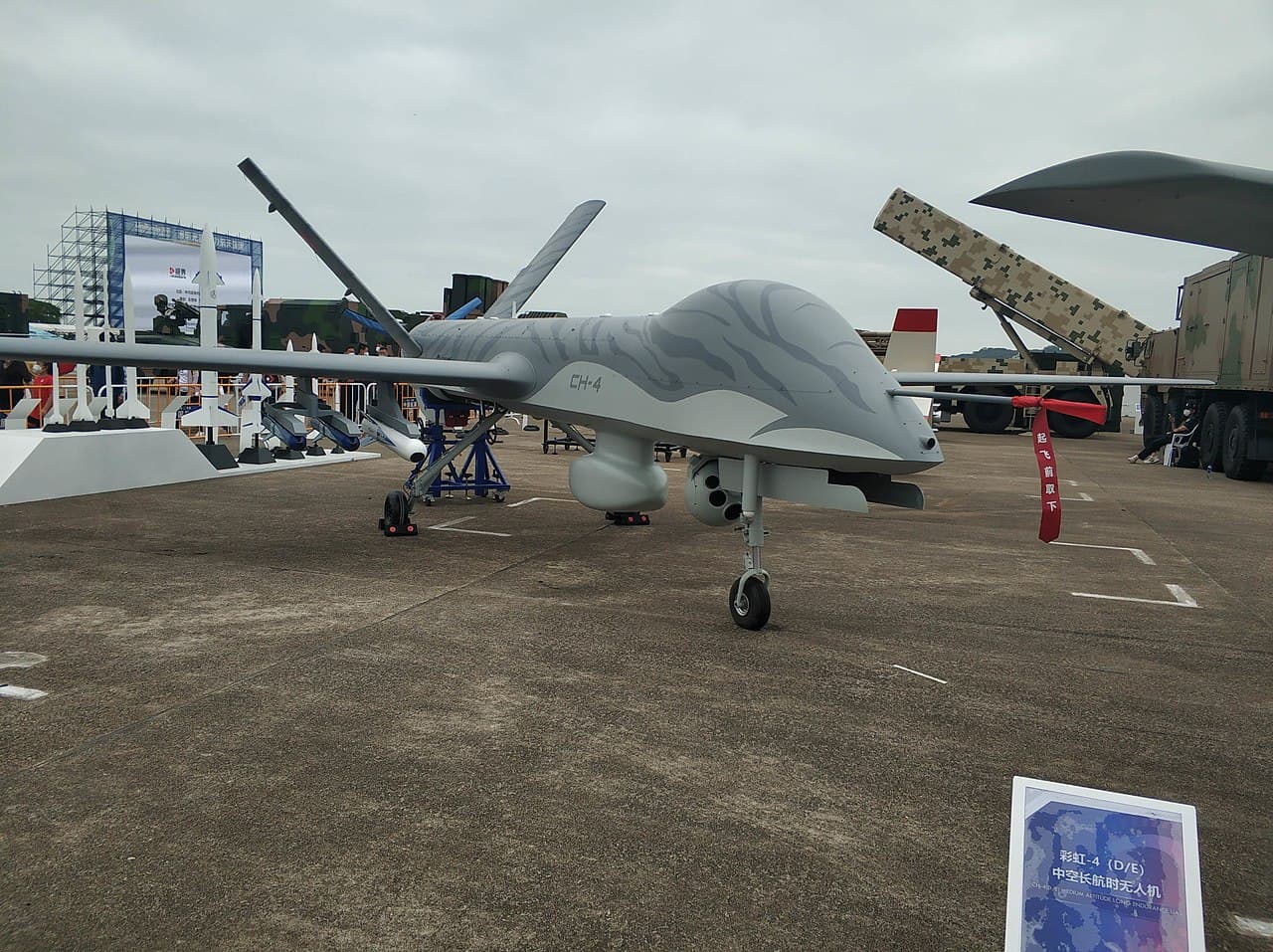
CH-4 Rainbow
The CH-4 Rainbow is China's most combat-tested armed drone, deployed by Iraq against ISIS in Anbar Province and by Saudi Arabia in Yemen. Manufactured by CASC, it was the first Chinese drone to achieve a confirmed combat kill and has since been exported across the Middle East and Africa, establishing China as a serious player in the global drone arms market.
Iraq Needed Drones. America Said Wait. China Said Yes.
Here's the story that explains the CH-4 Rainbow better than any spec sheet.
In 2014, ISIS overran roughly a third of Iraq. The Iraqi military desperately needed persistent surveillance and precision strike capability. They went to Washington and asked for MQ-1 Predators or MQ-9 Reapers. The US eventually provided unarmed ScanEagle drones and sped up Hellfire missile deliveries for Iraqi aircraft, but armed Predator or Reaper sales got stuck in congressional concerns, bureaucratic process, and the maze of the American export system.
China filled the gap. CASC delivered CH-4B drones to Iraq by early 2015, reportedly at around $4 million per system, a fraction of what American equivalents would have cost. Ground control stations, training, spares, and AR-1 missiles all included.
In October 2015, the Iraqi Air Force released footage of a CH-4B striking what it identified as an ISIS position in Anbar Province. AR-1 laser-guided missile, direct hit on a vehicle. First publicly confirmed kill by a Chinese-manufactured armed drone.
That single clip was worth more than any airshow brochure. It told every potential buyer on the planet that Chinese drones weren't just affordable alternatives. They worked. In real combat. Operated by a foreign military. Against a real enemy.
The Aircraft
The CH-4 sits in the broader CASC Rainbow (Cai Hong) family, which runs from the small CH-1 up to the CH-7 stealth drone. CASC, the China Aerospace Science and Technology Corporation, is one of China's two big state-owned aerospace conglomerates. They also run the space programme.
Two main variants. The CH-4A is reconnaissance-only with extended range and endurance. The CH-4B is the armed version that can carry weapons while keeping ISR capability. Same basic airframe.
The CH-4B first showed up publicly around 2012. The airframe is a high-wing monoplane with a conventional tail and a pusher propeller at the rear. Wingspan 18 metres, smaller than the Wing Loong II's 20.5 m or the MQ-9 Reaper's 20 m. Length 8.5 metres. Maximum takeoff weight about 1,330 kg, which slots it between the MQ-1 Predator (1,020 kg) and the Wing Loong II (4,200 kg). Roughly Predator-plus territory.
The engine is a piston motor, reportedly around 100 hp, driving the pusher prop. That's the main limitation compared to turboprop competitors. It constrains speed, altitude, and payload. Top speed about 235 km/h. Ceiling 8,000 metres. The CH-4A claims 30-40 hours endurance in clean configuration. The armed CH-4B, with weapons and the associated drag, is realistically limited to around 14 hours.
Weapons
Four underwing hardpoints carrying about 345 kg max. The menu is shorter than the Wing Loong II's, reflecting the smaller airframe:
- AR-1 laser-guided missile: The primary weapon. Semi-active laser guidance, roughly Hellfire-comparable. About 45 kg. Effective against vehicles and light structures.
- FT-5 GPS-guided bomb: Small precision munition for fixed targets.
- HJ-10 anti-tank missile: Adapted from the ground-launched Red Arrow system.
For counterinsurgency and low-intensity conflict, the AR-1 has been enough. CASC has claimed a 96% strike rate in combat, per a 2018 South China Morning Post report. Take that number with appropriate scepticism since it comes from the manufacturer and the targets were mostly ISIS and Houthi positions with no air defences. But even with marketing inflation factored in, the operational record appears genuinely competent.
Iraq: The Proving Ground
Iraqi CH-4Bs started flying combat missions over Anbar Province by mid-2015. The October footage was just the first public evidence; Iraqi sources indicated the drones had been operating for months already.
Through the rest of the anti-ISIS campaign, CH-4Bs flew regular combat sorties across western Iraq. ISIS convoys in the open desert terrain of Anbar were easy pickings from altitude: exposed, predictable, and completely unable to fight back against a drone orbiting thousands of metres above them.
Iraqi commanders reportedly valued two things above all else: persistence and responsiveness. Compared to manned aircraft, the CH-4B could loiter for hours, and when an intelligence tip came in, it could observe, confirm, and strike within a single mission cycle without the overhead of scrambling a manned strike package.
It wasn't all smooth. Reliability issues surfaced: communication link failures, maintenance difficulties. Iraqi technicians reportedly struggled with aspects of the ground support equipment, and spare parts from China didn't always arrive promptly. These are the kinds of problems any new system encounters in combat, but they were real enough that the after-sales support question has followed Chinese drone exports ever since.
Saudi Arabia in Yemen
Saudi Arabia deployed CH-4Bs in the Yemen campaign against Houthi forces, starting around the same time as the broader Saudi-led Operation Decisive Storm that began in March 2015. Both recon and strike missions along the border and into Houthi-controlled territory.
Yemen was harder than Iraq. The Houthis aren't sophisticated by global standards, but they've gotten increasingly competent at engaging medium-altitude drones. They used a mix of optically guided anti-aircraft guns, modified Soviet-era surface-to-air missiles, and reportedly Iranian-supplied systems to bring down multiple Saudi CH-4Bs.
By July 2022, open-source tracking indicated Saudi Arabia had lost at least twelve CH-4Bs in Yemen. That's a significant attrition rate, and it exposed a real design limitation: the CH-4B has essentially no electronic countermeasures or threat warning systems. It flies a predictable pattern at medium altitude, which makes it a feasible target for anyone with functioning radar and SAMs. In Iraq, ISIS couldn't touch it. In Yemen, the Houthis could.
Other Operators
Jordan has flown CH-4Bs for border surveillance and counterterrorism along the Syrian and Iraqi borders. Egypt acquired CH-4Bs alongside Wing Loong drones for Sinai operations. Algeria bought the system for border security. Nigeria has operated the CH-3 predecessor against Boko Haram since 2015 and has shown interest in the CH-4B. Pakistan has evaluated the type alongside the Wing Loong II.
The customer list keeps growing. These are mostly countries that need armed drone capability, have limited budgets, and either can't get Western drones or don't want the strings that come with them.
China's Internal Competition
One of the odder features of the Chinese drone export market: two state-owned corporations, CASC (CH-4 maker) and AVIC (Wing Loong maker), compete directly for the same customers. It's deliberate policy. Beijing fosters competition between state enterprises to drive innovation and push costs down.
The CH-4B and Wing Loong II occupy different segments. The CH-4B is smaller, lighter, cheaper, less capable. Roughly MQ-1 Predator class. The Wing Loong II is larger, pricier, and closer to MQ-9 Reaper territory. If you need a basic armed surveillance platform at minimum cost, the CH-4B is the better deal. If you need more endurance, heavier weapons, and greater flexibility, you go Wing Loong II.
Some customers buy both. Egypt runs Wing Loong and CH-4 variants for different mission profiles. The overlap gives China a product for every budget tier in the armed drone market.
The CH-4A: Recon Specialist
The unarmed CH-4A deserves a mention because its specs are quite different from the B variant. Without weapons drag and with more fuel, the CH-4A claims 30-40 hours of endurance and 3,500-5,000 km of range. If those numbers are accurate, it would be one of the longest-endurance piston-engined drones anywhere.
Several customers have acquired the CH-4A specifically for strategic reconnaissance, border surveillance, maritime patrol, and disaster response. Where weapons capability is either unnecessary or politically sensitive, the A variant makes sense.
The Rainbow Family
The CH-4 sits in a lineup that spans the full spectrum:
The CH-3 is the smaller predecessor, combat-proven in Nigeria. The CH-5 is the bigger platform, often called "China's Reaper," with claims of 60 hours endurance and 16 hardpoints. The CH-6 targets the high-altitude strategic recon market. The CH-7 is a stealth flying-wing combat drone for high-end operations.
That family approach mirrors what General Atomics did with Predator/Reaper/Avenger. A customer who buys a CH-4B for immediate needs can upgrade to a CH-5 later without switching suppliers, keeping commonality in training, maintenance, and ground infrastructure. It's a smart commercial strategy.
Where It Falls Short
The limitations are well-documented and combat-proven in the unflattering sense.
The piston engine is the core constraint. At 235 km/h and 8,000 m ceiling, the CH-4B is slower and lower than turboprop competition. That makes it more exposed to air defences and less efficient at covering large areas.
Payload capacity of 345 kg limits you to four small munitions. Compare that to a Reaper carrying over 1,300 kg of external ordnance. Dramatically less firepower, dramatically less flexibility in weapons selection.
Fourteen hours of armed endurance is workable but falls well short of the Wing Loong II or Reaper. For a platform whose fundamental value is persistence, that gap matters.
Survivability in contested airspace is minimal. Yemen proved that. Even modest air defences imposed significant attrition. Against anything resembling a modern integrated air defence system, the CH-4B wouldn't last.
The after-sales support question is real. Reports from Iraq and elsewhere describe spare parts delays, documentation gaps, and field service responsiveness that doesn't match Western or Israeli standards. CASC has reportedly improved over time, but the perception lingers. A drone grounded waiting for a part is a drone not flying, and for buyers who chose the CH-4 specifically because they needed capability immediately, support responsiveness is a core concern.
Nobody has abandoned the platform over it, though. Which tells you the issues, while real, haven't outweighed the fundamental value proposition.
What It Changed
The CH-4 Rainbow's significance isn't about being the best drone. It's about being the one that proved China could compete.
Before the CH-4, armed drone exports were an American-Israeli near-monopoly. Both restricted sales and attached conditions. The CH-4 broke that model. It offered a genuine combat-capable armed drone at a price developing nations could actually pay, without the political strings that made Western systems unreachable.
Iraq's acquisition was the watershed. When a US ally, actively fighting with American military support, chose a Chinese drone because the American system wasn't available, the market changed permanently. Every subsequent Chinese export, the Wing Loong II sales, the CH-5, the expanding customer lists across the Middle East and Africa, traces back to that CH-4B proving over Anbar that Chinese drones are not airshow props. They work.
The monopoly is over. The CH-4 is what broke it.
Sponsored
Place your ad hereSpecifications
| Wingspan | 18 m (59 ft) |
| Length | 8.5 m (27.9 ft) |
| Max Takeoff Weight | 1,330 kg (2,932 lb) |
| Payload | 345 kg (761 lb) |
| Max Altitude | 8,000 m (26,250 ft) |
| Endurance | 30–40 hours (CH-4A), 14 hours (CH-4B armed) |
| Max Speed | 235 km/h (146 mph) |
| Cruise Speed | 180 km/h (112 mph) |
| Engine | Piston engine (100 hp class) |
| Armament | AR-1 laser-guided missiles, FT-5 GPS-guided bombs, HJ-10 anti-tank missiles |
| Hardpoints | 4 (wing) |
| Range | 3,500–5,000 km (CH-4A), 250 km line-of-sight (CH-4B) |