Drones of War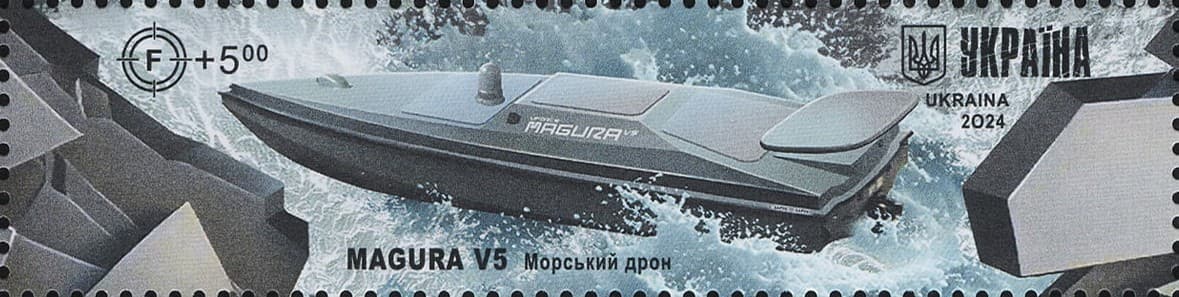
MAGURA V5
The MAGURA V5 is an unmanned surface vessel developed by Ukrainian intelligence that sank multiple Russian warships in the Black Sea, proving that cheap autonomous boats could neutralise a conventional navy.
The Kill List Is the Story
Start with what the MAGURA V5 actually did, because the engineering matters less than the results.
In February 2024, a pack of these drones swarmed the Ivanovets, a Project 12411 Tarantul-class missile corvette, near occupied Crimea. HUR (Ukraine's military intelligence directorate) released the footage: multiple USVs converging from different bearings simultaneously. The corvette's crew opened up with deck guns and hit at least one drone. Didn't matter. The others punched through and the Ivanovets went down. A 550-tonne warship carrying anti-ship missiles and close-in weapon systems, killed by boats you could fit on a flatbed truck.
Two weeks later, they got the Caesar Kunikov. Project 775 Ropucha-class landing ship, over 4,000 tonnes fully loaded. That was the first large warship ever sunk by an unmanned surface vessel. The Caesar Kunikov was the third Russian landing ship lost in the war (after the Saratov at Berdyansk in March 2022 and the Novocherkassk to a Storm Shadow in December 2023), but the method of its killing was new.
Then in March 2024, the Sergiy Kotov. This one stings if you're a Russian naval planner. The Project 22160 patrol ship was commissioned in 2022 and was specifically tasked with counter-USV patrols. The ship sent to hunt the drones got killed by them.
Beyond these headline sinkings, MAGURA V5 operations damaged multiple other vessels and forced what amounts to a Russian retreat from western Crimean waters. The bulk of the Black Sea Fleet's surface combatants pulled back to Novorossiysk on the Russian mainland. Ukraine, a country without a functioning navy, achieved sea denial across a large stretch of the Black Sea. That sentence still reads as absurd, and yet here we are.
How Ukraine Got Here
Some context. Ukraine lost most of its navy in the first weeks of the 2022 invasion. The flagship frigate Hetman Sahaidachny was scuttled in port to avoid capture. What was left: a handful of patrol boats and a coastline blockaded by Russian cruisers, frigates, missile corvettes, and patrol ships enforcing a near-total maritime exclusion zone.
The conventional play would have been to accept that. No surface combatants to challenge the fleet, no submarines, no anti-ship missile batteries with the range to matter (not at the war's outset, anyway). But HUR took a different approach: build a fleet of unmanned surface vessels from scratch, designed to find and sink warships at a fraction of what those warships cost.
The MAGURA V5 came out of that program. The name is a recursive Ukrainian acronym (Maritime Autonomous Guard Unmanned Robotic Apparatus) and V5 marks the fifth design iteration, evolved through the kind of rapid prototyping that only wartime urgency produces. STE (Special Technology Enterprise) first showed it publicly at IDEF in Istanbul, July 2023.
The Boat Itself
At 5.5 metres long, the MAGURA V5 sits very low in the water. Minimal freeboard, which is the whole point: it barely shows up on radar returns already cluttered by wave action. At night or in moderate seas, good luck spotting one visually.
The propulsion setup is a jet drive, no exposed propellers, pushing it to around 42 knots (78 km/h). That's fast enough to complicate life for a ship's crew trying to engage with manual weapons. Operational range is cited at roughly 800 km, which from Ukraine's coast covers most of the western Black Sea, Crimean waters included, and the approaches to Sevastopol.
For guidance, it uses GPS/INS navigation paired with a satellite comms link for real-time operator control via encrypted video from an onboard EO camera. In practice, the operator sends the USV toward the target area on autopilot using waypoint navigation, then takes direct control for the terminal run. Autonomous transit, human-in-the-loop for the kill. It's a sensible split: you get the range without gambling the targeting precision on full autonomy.
Warhead payload is around 320 kg of HE for the standard direct-impact profile, though exact figures vary by configuration. HUR has also shown off MAGURA V5 variants kitted out for other jobs: some carrying missile launch tubes for stand-off attacks, others reportedly configured as mine-layers. The platform flexibility is worth noting, even if the ship-killer role gets all the attention.
Why It Worked (and Why That's Worrying)
The question worth asking: why couldn't a navy with functioning CIWS, radar, and armed crew repel 5.5-metre boats?
Part of it is numbers. Every recorded attack used multiple USVs coming in from different bearings at once. Three or four small targets converging at 40-plus knots from different directions creates a geometry problem that saturates most point-defence setups. You can't engage them all simultaneously, and the one you miss is the one that kills you.
Part of it is detection. These things are genuinely hard to see. Ship radars built to track aircraft and anti-ship missiles struggle with sea-skimming targets that have tiny radar cross-sections in messy sea states. At night, visual detection drops to a few hundred metres at best.
And part of it is that the Black Sea Fleet simply wasn't ready for this. The AK-630 rotary cannon systems on most Russian ships were designed for anti-missile defence, not for sustained engagement against surface targets approaching at wave height from multiple vectors. Sensor alignment, crew readiness, the sheer novelty of the threat: all of it contributed.
Then there's the cost arithmetic, which is brutal. A MAGURA V5 is estimated in the low hundreds of thousands of dollars. The ships it sank are worth tens to hundreds of millions. Even with a 90% interception rate, the attacker wins on exchange ratio. That math doesn't have a good answer for the defender without rethinking how surface combatants protect themselves from the waterline up.
Production, Operators, and the Export Question
HUR runs the program, not the Ukrainian Navy, which tells you something about its origins as an unconventional warfare initiative rather than a normal procurement. STE handles manufacturing, dispersed across multiple sites for survivability against Russian strikes.
Nobody's publishing production numbers. But the tempo of operations through 2024 and into 2025 makes clear that output scaled well past prototype quantities some time ago. Ukraine has signalled interest in export versions too; the IDEF 2023 showing was as much a sales pitch as a public debut.
As of early 2026, Ukraine remains the only confirmed operator, though plenty of navies are paying close attention.
The Caveats
None of this means the MAGURA V5 is some kind of invincible weapon. The operational context matters a lot.
A 5.5-metre boat on the Black Sea is weather-dependent. Winter storms, heavy wave heights: sensors degrade, speed drops, the thing risks swamping, and the satellite link gets flaky. The Black Sea is sheltered compared to open ocean, which helps, but there are seasonal windows where you're not launching much of anything.
Every standard attack run is one-way. The USV detonates on impact. Unlike a missile fired from a reusable launcher, each strike consumes the whole vehicle. At an estimated $200,000-$500,000 per unit, the economics still favour the attacker by a wide margin, but you need a production line that can keep feeding the campaign.
The satellite comms dependency is the obvious vulnerability. Real-time operator control during the terminal phase needs a functioning link. Russian EW capabilities in the theatre are not trivial, and the jamming-versus-resilience contest between the two sides is ongoing and not publicly well understood. If the link drops at the wrong moment, you've got a blind, uncontrollable boat in the water.
And the first-mover advantage won't last forever. The MAGURA V5 worked in part because the Russian fleet was caught flat-footed by a threat nobody had fielded at this scale before. Navies that study these engagements and invest in counter-USV defences (directed energy, autonomous interceptor drones, better radar for small surface targets) will be harder to hit. The open question is whether offensive USV development stays ahead of the countermeasures. I'd bet on the offence for now, but that's a bet, not a certainty.
The Bigger Picture
Ukraine didn't invent unmanned surface warfare. The Houthis used explosive boats against Saudi and Emirati vessels in the Red Sea. Iran has armed USV concepts. But nobody before Ukraine ran a sustained, large-scale USV campaign against a major navy, sank multiple warships, and achieved actual strategic outcomes: the Black Sea Fleet withdrew from its forward positions, the naval blockade broke in practice, and commercial shipping resumed to Ukrainian ports.
What should worry naval planners everywhere is how the Ukrainians pulled it off. They lost their navy, built a replacement from commercial components, waterjet engines, and satellite links, and used it to functionally defeat a fleet that included cruisers and frigates. The whole thing can be manufactured in workshops and launched from any stretch of coastline. No launch platforms, no detection infrastructure, no blue-water fleet required.
Every major navy is now trying to work out what that means for the future of surface warfare. The answers aren't going to make anyone who owns big, expensive ships sleep well at night.
Sponsored
Place your ad hereSpecifications
| Length | 5.5 m |
| Beam | 1.5 m (estimated) |
| Weight | 450 kg (estimated) |
| Max Speed | 42 knots (78 km/h) |
| Range | 800 km |
| Warhead | Multiple configurations (~320 kg payload) |
| Guidance | GPS/INS + satellite link + remote operator |
| Sensors | Electro-optical day/night camera |
| Propulsion | Jet drive |