Drones of War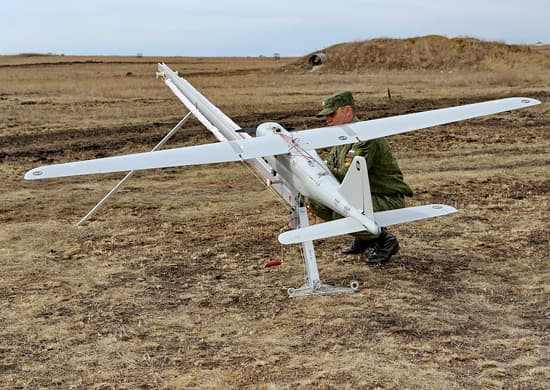
Orlan-10
The Orlan-10 is Russia's most widely deployed tactical drone, a hand-launched reconnaissance platform that has become the backbone of Russian artillery targeting in Ukraine. Built with consumer-grade components including Canon cameras and Japanese engines, it represents a radically different approach to military drone design — cheap, expendable, and produced in the thousands.
The Canon Camera That Changed the War
Early in the full-scale invasion, Ukrainian soldiers shot down a small drone and tore it apart. What they found inside became one of the war's most shared images on military social media: a Canon consumer camera, duct-taped wiring, a fuel tank that looked like a repurposed plastic bottle, and a grab bag of commercial electronics that belonged in a hobbyist's workshop. The drone was an Orlan-10. And it was already the single most operationally important unmanned system Russia had in the field.
Western observers did what Western observers do. They laughed. How does a military that spends billions on Su-57s and Iskander missiles go to war with a drone containing a point-and-shoot camera?
The mockery missed the point completely. The Orlan-10 was never supposed to be sophisticated. It was supposed to be there, in numbers, when it mattered. On that score, it's succeeded more than any other Russian drone programme by a wide margin.
What You're Actually Looking At
Small tactical UAV developed by the Special Technology Centre (STC) in Saint Petersburg. Development started around 2010, and the system entered Russian military service shortly after.
The airframe is straightforward: high-wing monoplane, tractor propeller at the nose. Wingspan 3.1 metres, roughly the size of a large model aircraft. Fuselage about 1.8 metres long. Empty weight 12.5 kg, max takeoff weight 16.5 kg, leaving around 5 kg for payload. It launches from a folding catapult that a small crew can set up in minutes, and it comes home by parachute. Engine cuts, chute deploys, the thing drifts down, the crew collects it, refuels, and sends it up again. No runway. A clearing is enough.
The engine is a small internal combustion piston motor. Early variants reportedly used Japanese-made Saito engines, which became a big deal for sanctions investigators later. More recent production batches have used various engines, with Russia claiming domestic alternatives exist. Whether those alternatives actually match the Saito's reliability is an open question.
Top speed about 150 km/h. Cruise 90-110 km/h. Endurance of 16-18 hours, which is genuinely impressive for something this small. Ceiling 5,000 metres.
Why Consumer Parts Are the Whole Point
The Orlan-10's reliance on commercial off-the-shelf components has been dissected in detail by RUSI (Royal United Services Institute), which published a supply chain analysis in 2022 that became a reference document for sanctions enforcement.
The primary sensor is a Canon consumer digital camera, typically a Canon EOS series, mounted in the fuselage behind a window cut in the belly. Navigation uses commercial GPS receivers. The data link runs on commercial radio modules. The onboard processor is based on commercially available microcontrollers. Some recovered examples had fuel tanks made from modified plastic containers.
This isn't laziness. It's a design philosophy with two sharp consequences.
First, per-unit cost is extraordinarily low. Estimates run $87,000 to $120,000 per aircraft, compared to millions for Western tactical drones. You can lose five Orlan-10s for the cost of one mid-range anti-aircraft missile used to shoot them down. That economic asymmetry is central to how Russia uses the system.
Second, it makes the whole programme vulnerable to sanctions. After 2022, Western governments went after the supply chain specifically: Canon cameras, Saito engines, electronic components being procured for re-export to Russia. How effective those sanctions have been is debatable. Russia has continued fielding Orlan-10s in significant numbers through 2023, 2024, and into 2025. But procurement costs and difficulty have reportedly gone up.
The System Is What Matters
Looking at an individual Orlan-10 misses the point. The aircraft anchors a system. A typical deployment includes a launch vehicle with the catapult, a command vehicle with the ground control station, and sometimes a relay vehicle. The system can control multiple drones simultaneously.
The standard tactical deployment uses two or three drones together. First one flies at 1,000-1,500 metres providing primary reconnaissance imagery. Second one might carry an electronic warfare payload for jamming enemy comms or GPS. Third can serve as a comms relay, extending data link range. That multi-drone, multi-role architecture is considerably more sophisticated than the crude construction of any individual airframe would suggest.
The ground station processes imagery and pushes targeting data directly to artillery batteries through Russia's automated fire control systems. When everything works as designed, the cycle from a drone spotting a target to the first shells landing is as short as three minutes. That speed is the Orlan-10's real contribution to Russian combat power.
Artillery Targeting in Ukraine
This is where the Orlan-10 found its defining purpose, and I think it's worth spending time on because it explains why this crude little aircraft matters so much.
Russia's military has always been artillery-centric. Russian batteries fire more rounds per day than any other modern military. But artillery without accurate targeting is just noise and wasted ammunition. You need someone watching where the shells land and calling corrections. The Orlan-10 does that at industrial scale.
Russian artillery batteries deployed with organic Orlan-10 support could observe Ukrainian positions in real time, transmit coordinates to fire control systems, watch their rounds impact, and send corrections. All within minutes. The concept isn't new, obviously. What's new is having it available across virtually every brigade-level formation because the drone is cheap enough to distribute that widely.
The results in the Donbas fighting of 2022-2023 were brutal. Ukrainian forces reported that spotting an Orlan-10 overhead was frequently the prelude to accurate artillery bombardment. Killing the drone before it could transmit targeting data became an urgent priority, which in turn drove demand for counter-UAS systems that has reshaped the whole technological character of the war.
Ukrainian forces have shot down hundreds of Orlan-10s. Oryx, the open-source tracking site, had documented over 90 visually confirmed losses as of early 2024, with the actual total almost certainly several times higher. Russia has kept fielding them in large numbers regardless, which tells you about the scale of stockpiles and ongoing production.
The EW Variant
Beyond reconnaissance, the Orlan-10 has been used in electronic warfare configurations that have been surprisingly effective for something so small.
The EW variant jams enemy radio communications across a wide frequency band, disrupting tactical radio nets in its area of effect. Russian forces have also used Orlan-10s for what's been called "SMS bombing," broadcasting text messages to Ukrainian soldiers' mobile phones with propaganda or threats while simultaneously hoovering up electronic intelligence from the signals environment.
It can also jam GPS locally, degrading the accuracy of GPS-guided munitions and navigation systems. In a war where both sides depend on GPS for everything from drone navigation to precision artillery, selectively denying GPS coverage from a cheap, expendable platform is a bigger deal than it might sound.
The combination of recon and EW in one low-cost platform family is probably the Orlan-10's most genuinely innovative feature. Russian commanders can create layered drone coverage: some watching, some jamming, some relaying data. All from the same replaceable system.
Before Ukraine
The Orlan-10 first saw combat in eastern Ukraine in 2014, during the initial Russian-backed separatist fighting in Donbas. Ukrainian forces recovered downed examples that year, providing early material evidence of direct Russian military involvement.
Syria came next. Russian forces deployed Orlan-10s from 2015 in support of Assad, using them for reconnaissance over rebel areas and to target Russian and Syrian artillery. The Syrian deployment gave STC operational feedback that reportedly shaped later upgrades.
The 2020 Nagorno-Karabakh war was less kind to the type. Orlan-10s deployed on the Armenian side, reportedly supplied by Russia, but their effectiveness was marginal compared to Azerbaijan's Bayraktar TB2s and Israeli IAI Harop loitering munitions, which dominated the air picture. The contrast was stark: the Orlan-10 could watch, but it couldn't shoot. In a fight where air-to-ground strike capability proved decisive, being eyes-only was a real limitation.
Production Scale
The exact number built is unknown outside Russian defence circles, but estimates point to well over 1,000 airframes, possibly several thousand. It's the most widely produced military drone in Russian history.
Production reportedly continued through the post-2022 sanctions environment, though at what rate and with what component substitutions is unclear. Russian state media has periodically claimed expanded capacity and full import substitution for critical components. Western analysts are sceptical about the quality of substitute parts.
The type has been supplemented by the Orlan-30, an upgraded variant with better optics and a laser designator, and by the explosion of FPV attack drones on both sides. But the baseline Orlan-10 remains in widespread service as the standard tactical ISR platform.
Exports
Myanmar's military has reportedly received Orlan-10s for use in its internal conflicts. Reports of transfers to African and Central Asian states exist but are less well documented. The low cost and minimal infrastructure requirements make it attractive to militaries that can't afford much else.
The Limitations Are the Design
The 5 kg payload can't carry weapons. The Orlan-10 watches and reports. It finds targets for other systems to destroy. In a military that builds its tactical formations around artillery, this isn't necessarily a problem. But it means the Orlan-10 can't react to fleeting targets the way an armed drone can. If something appears and disappears in minutes, the Orlan-10 can tell you it was there, but that's all.
Consumer-grade components mean lower reliability than mil-spec equivalents. The Canon camera isn't weatherproofed to military standards. The commercial GPS receiver is more susceptible to jamming. The small engine doesn't love bad fuel or extreme temperatures.
Data link range is nominally 120 km, extendable to about 600 km with relay aircraft. That keeps the Orlan-10 tethered to relatively close operations compared to satellite-linked systems.
The Counter-UAS Arms Race
The Orlan-10's ubiquity has spawned an entire counter-UAS ecosystem on the Ukrainian side, and the cat-and-mouse dynamic between the drone and the methods developed to kill it has become one of the war's most important technology competitions.
EW systems that jam the data link work well, causing drones to lose contact and either crash or revert to autonomous return modes. Anti-aircraft guns, particularly the Soviet-era ZU-23-2 23mm autocannon, have proven effective against low-flying Orlan-10s. The slow speed and predictable flight patterns make it a feasible target for optically aimed fire, though the small size complicates visual acquisition.
MANPADS have been tried but the piston engine's low infrared signature makes heat-seekers less effective than they'd be against something bigger and hotter. Small arms fire has occasionally brought them down at lower altitudes. FPV interceptor drones, small and fast and cheap, have been adapted to ram Orlan-10s in flight or detonate small charges nearby. That drone-on-drone aerial combat is something genuinely new.
Despite all of it, the Orlan-10 keeps flying. Russia can produce and launch them faster than Ukraine can shoot them down. Each one costs maybe $100,000. Each missile used against one may cost several times that. The math favours the operator, and that math has implications well beyond this war.
What This Drone Actually Teaches
The Orlan-10 is not a remarkable aircraft. The sensors are mediocre. Build quality is inconsistent. Nothing about it is military-grade in the Western sense. Any individual Orlan-10 gets outperformed by almost any Western tactical drone you care to name.
But that's the wrong comparison. Russia understood that the marginal value of one perfect drone is less than the cumulative value of a thousand adequate ones. The Orlan-10 worked because it was cheap enough to lose in quantity, simple enough to maintain under field conditions, and effective enough to provide the targeting data that made Russian artillery measurably more lethal.
Every military watching Ukraine has absorbed that lesson. The era of exquisite, low-quantity drones isn't over, but the assumption that quality always beats quantity has taken a serious hit. Sometimes the best sensor platform is the one that's actually airborne over the battlefield, even if it's got a Canon camera and a plastic fuel tank.
The drone is crude. The impact is not.
Sponsored
Place your ad hereSpecifications
| Wingspan | 3.1 m (10.2 ft) |
| Length | 1.8 m (5.9 ft) |
| Max Takeoff Weight | 16.5 kg (36.4 lb) |
| Empty Weight | 12.5 kg (27.6 lb) |
| Payload | 5 kg (11 lb) |
| Max Altitude | 5,000 m (16,400 ft) |
| Endurance | 16–18 hours |
| Max Speed | 150 km/h (93 mph) |
| Cruise Speed | 90–110 km/h (56–68 mph) |
| Engine | Internal combustion piston engine (consumer-grade) |
| Sensors | Canon EOS camera, IR sensor, EW payload |
| Launch Method | Folding catapult |
| Recovery | Parachute |
| Range | 120–600 km (telemetry dependent on relay) |