Drones of War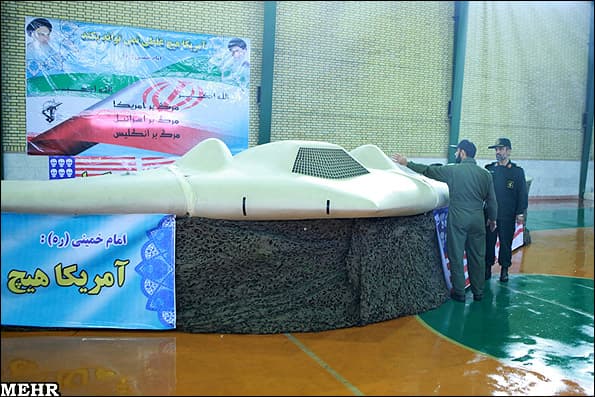
RQ-170 Sentinel
The RQ-170 Sentinel is a classified stealth reconnaissance drone that provided surveillance during the 2011 raid that killed Osama bin Laden, then made headlines again when Iran captured one intact — exposing America's most secret unmanned aircraft.
The Drone Nobody Was Supposed to See
Everything interesting about the RQ-170 Sentinel happened because it stopped being secret.
For years it was just a rumour, a ghost shape in blurry photos from Kandahar. Then, in the space of seven months in 2011, it became the most famous classified aircraft in the world. On 1 May, a Sentinel orbited above Abbottabad, Pakistan while Navy SEALs stormed the compound where Osama bin Laden was hiding. It fed real-time video and signals intelligence to the command team watching from the White House Situation Room. The drone had apparently been watching the compound for weeks, possibly months, helping analysts determine that the tall figure seen walking the courtyard was likely bin Laden himself.
On 5 December that same year, Iran announced it had captured an RQ-170 largely intact. The drone had come down near Kashmar, about 225 km from the Afghan border, and the Iranians paraded it on state television. There it was: the flying-wing shape, the smooth radar-absorbent skin, the top-mounted engine intake designed to hide the exhaust from ground-based infrared sensors. All on camera.
Iran said they'd hacked its GPS and guided it to a landing. The US suggested a malfunction. Take your pick. But the result was the same: one of America's most closely guarded reconnaissance platforms was sitting on an Iranian runway being photographed from every angle.
The "Beast of Kandahar"
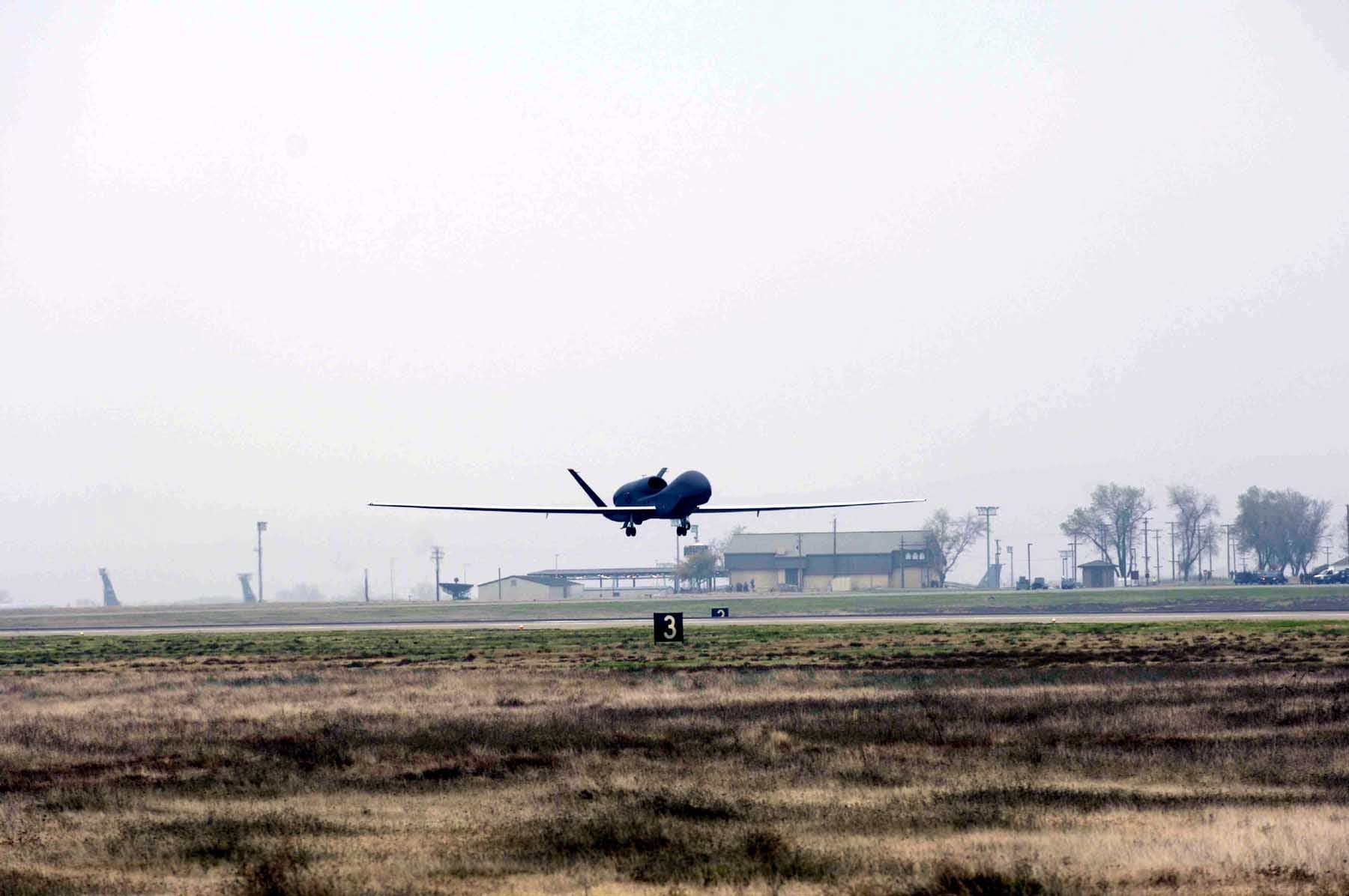
The Sentinel first surfaced in 2007, thanks not to any government disclosure but to aviation spotters at Kandahar Airfield who photographed something they didn't recognise. The images were grainy but clear enough: a tailless flying wing, smooth and clean, with a wingspan that analysts estimated around 20 metres. Clearly a stealth design. Aviation Week published the photos, and the internet gave it a name: the Beast of Kandahar.
The Air Force didn't acknowledge the RQ-170 until December 2009, and even then they confirmed almost nothing. A "low-observable" unmanned aircraft. Built by Lockheed Martin. Operated by the 30th Reconnaissance Squadron out of Tonopah Test Range, Nevada. That last detail was telling on its own: Tonopah is where they based the F-117 Nighthawk during its secret years. Same kind of programme, same kind of secrecy.
What Lockheed's Skunk Works actually built, based on what we can see and infer, is a stealthy ISR platform meant to fly where Predators and Reapers can't. Those aircraft work fine when you own the airspace. They're slow, not particularly hard to spot on radar, and they'd get swatted down in minutes over any country with capable air defences. The Sentinel was designed for the harder problem: getting eyes into contested airspace without being detected. Pakistan, Iran, maybe North Korea. Places where the US needed intelligence but couldn't afford to be caught looking.
The flying-wing shape minimises the radar cross-section from the front and sides. The engine intake sits on top of the fuselage so ground radars can't see the compressor face, which is one of the biggest radar reflectors on any jet-powered aircraft. The exhaust is probably mixed or shielded to cut down the infrared signature. None of this is confirmed officially, but the design speaks for itself.
Specs, Such As They Are
Here's where writing about the Sentinel gets frustrating. Almost everything is classified, and the estimates that exist come from photographic analysis, the captured Iranian example, and scattered official remarks that were never meant to reveal much.
Wingspan: roughly 20 metres (66 feet). That makes it bigger than a Predator but a lot smaller than a Global Hawk. The fuselage is compact, maybe 4.5 metres long, with most of the internal space given over to fuel and sensors. There are no visible weapons bays or external hardpoints in any photograph. This is a pure reconnaissance bird.
The engine is thought to be a variant of the General Electric TF34 turbofan, same family that powers the A-10 Thunderbolt II. That would give it decent thrust and fuel efficiency for medium-altitude work, but nothing like the 30-plus hour endurance you get from a Global Hawk. Best estimates put the Sentinel's endurance around 5 to 6 hours. Enough for a targeted collection mission; not enough for persistent surveillance.
The sensor suite? That's the most tightly held part. Analysis of the captured airframe and the context of known missions suggests EO/IR cameras, synthetic aperture radar, and SIGINT collection gear. Some analysts have speculated about communications relay capability or the ability to vacuum up electronic intelligence from air defence radars, but that's firmly in the realm of educated guesswork.
What Happened in Iran
The December 2011 capture is still one of the most argued-over incidents in recent drone history, and I'm not sure we'll ever get a definitive answer.
Iran's story: their electronic warfare units detected the Sentinel operating along the Afghan-Iranian border, spoofed its GPS signal, and guided it down to an Iranian military airfield. If true, that's an extraordinary feat. You're essentially hijacking a classified American aircraft in flight.
The American side has never laid out its version in detail, but the understood explanation is some kind of control system failure or comms loss that sent the drone drifting into Iranian airspace, where it landed or crash-landed more or less intact. The fact that the airframe showed relatively little damage, nothing like you'd expect from an uncontrolled crash, does lend some weight to the Iranian claim. But it's not conclusive.
What we know for certain: Iran got a mostly intact RQ-170. They've since claimed to have reverse-engineered it into two drones: the full-scale Shahed-171 Simorgh and the smaller 60%-scale Shahed-191 Saegheh. It looks vaguely like the Sentinel from the outside. Western analysts are sceptical about how much capability actually transferred. Iran also reportedly shared technical data from the captured drone with Russia and China, though the extent of any technology transfer is anyone's guess.
The strategic fallout was real regardless. The loss gave adversaries a physical example of American stealth drone technology: the materials, the radar-absorbent coatings, potentially the sensor and communications hardware. And it showed, in the most public way possible, that even America's most classified drones could be lost and exploited.
Where It Flew
Beyond Abbottabad and the Iran loss, the Sentinel's operational record is mostly classified. But you can piece together a rough picture.
Afghanistan from 2007 to at least 2014, based out of Kandahar. The missions were almost certainly ISR along the Afghan-Pakistan border, and probably over Pakistan itself. You don't station a stealth drone at Kandahar to look at things your Reapers can already see. The whole point was going where detection by Pakistani radar would have been a diplomatic disaster.
The bin Laden surveillance is the one confirmed Pakistan mission. Reporting indicates the Sentinel spent an extended period watching the Abbottabad compound before the raid, providing full-motion video that helped build the case for the operation.
The Iran loss near Kashmar strongly suggests surveillance of Iranian nuclear facilities, military sites, or missile development programmes. Kashmar is in northeastern Iran, within reach of several known sensitive sites.
North Korea is widely suspected but unconfirmed. The Sentinel's stealth would be especially relevant there, given the density of North Korean air defences along the DMZ and deeper inside the country. There have also been unconfirmed reports placing the aircraft at Andersen Air Force Base in Guam, which would point toward missions related to Chinese military activity in the Western Pacific.
The 30th Reconnaissance Squadron handles operations. CIA involvement in tasking, particularly for the bin Laden and Iran missions, is widely reported but officially unacknowledged. No other country operates the type.
The Capture Problem and Other Limits
The most glaring limitation is obvious: one of these things ended up on Iranian television. Whatever the cause, the fact that an intact Sentinel was recovered by an adversary represents a failure of the self-destruct or data-erasure protocols that are supposed to be standard on classified platforms. Whether those systems failed or were never triggered, the result was a strategic intelligence loss that went well beyond one airframe.
The 5-to-6-hour endurance ceiling keeps the Sentinel focused. It goes in, collects, and comes back. It can't park itself over a target for days like a Global Hawk. And the lack of weapons makes it a sensor platform only, which in an era of armed drones feels like an older way of thinking, though there are obviously missions where staying invisible matters more than being able to shoot.
Then there's the secrecy itself. The Sentinel's true contribution is impossible to evaluate from the outside. It may have produced intelligence that changed the course of events in ways we'll never learn about. That's sort of the point, but it also means the programme's actual value remains a matter of faith rather than evidence.
Where It Sits in the Bigger Picture
The RQ-170 probably isn't the most advanced stealth drone in American service anymore. Programmes like the RQ-180 are believed to have taken over the mission with greater capability. But the Sentinel is the one that surfaced: photographed at Kandahar, circling above the bin Laden raid, sitting in an Iranian hangar being examined by engineers who never expected to see anything like it.
What it proved matters more than what it is. The Predator generation showed that drones could watch. The Sentinel showed they could watch in places where the enemy was trying to stop them. Unmanned stealth reconnaissance, flying into contested airspace without a pilot and without detection, had previously been in the domain of manned aircraft like the F-117 and B-2. The Sentinel demonstrated it could be done for less money and zero risk to aircrew. That principle now drives some of the most expensive and most classified line items in the US defence budget. What exactly has come after the Sentinel is, fittingly, still secret.
Sponsored
Place your ad hereSpecifications
| Wingspan | 20 m (66 ft) estimated |
| Length | 4.5 m (15 ft) estimated |
| Max Takeoff Weight | Classified |
| Ceiling | 15,000 m (50,000 ft) estimated |
| Endurance | Classified (estimated 5-6 hours) |
| Engine | General Electric TF34 variant (estimated) |
| Propulsion | Single turbofan (top-mounted intake) |
| Sensors | EO/IR, SAR radar, SIGINT (all estimated) |
| Stealth Features | Flying wing, radar-absorbent materials, shielded exhaust |