Drones of War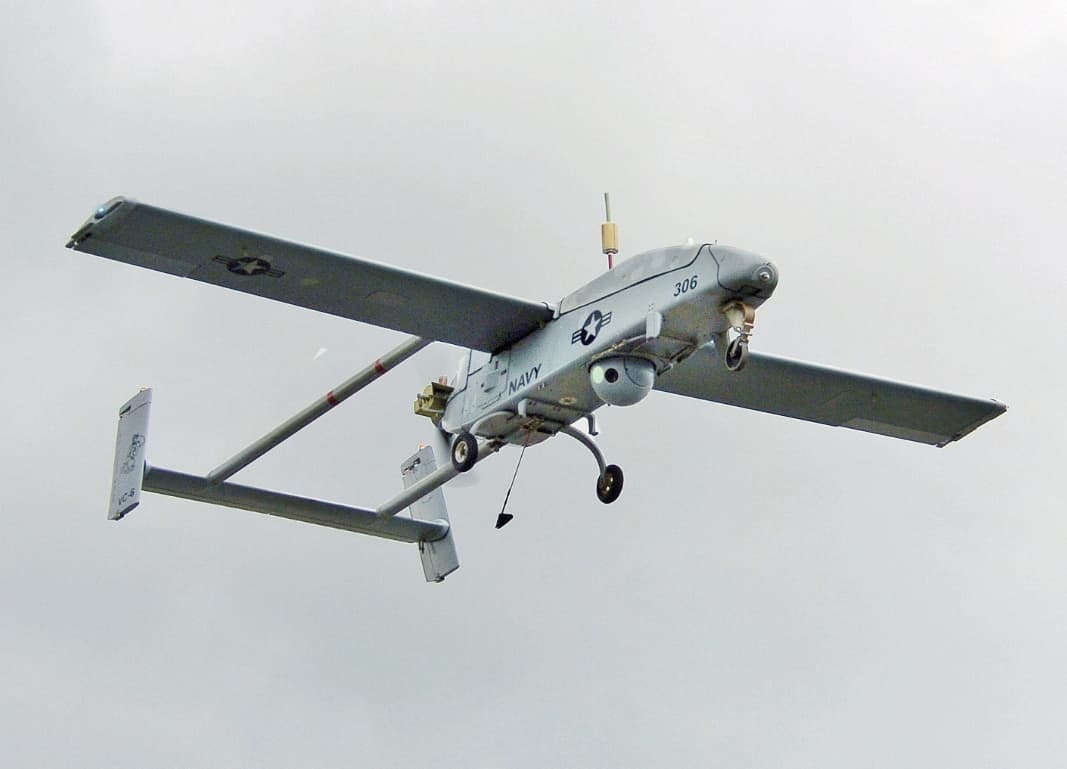
RQ-2 Pioneer
The RQ-2 Pioneer made history during the 1991 Gulf War when Iraqi soldiers surrendered to one, marking the first time in warfare that troops gave up to an unmanned aircraft. It pioneered naval drone operations from battleships and set the stage for everything that followed.
Soldiers Waving White Sheets at a Robot
Faylaka Island, off the Kuwaiti coast, February 1991. A group of Iraqi soldiers hear the familiar buzz overhead and do something no troops have done before in any war: they wave white flags and bedsheets at a drone.
The aircraft was an RQ-2 Pioneer, a squat, awkward-looking reconnaissance plane launched from the battleship USS Wisconsin. It had been assessing damage from the Missouri's 16-inch guns on Iraqi positions, and the Iraqis had figured out the pattern. That buzzing sound meant 860-kilogram shells were about to start landing on you with camera-guided accuracy. Surrender beat waiting for the next salvo.
By most accounts, it was the first time soldiers ever surrendered to an unmanned vehicle. That story became the Pioneer's calling card, but there's a bigger one behind it: how a small, cheap Israeli drone became America's introduction to the age of unmanned aviation.
The Israeli Connection
The Pioneer started life in Israel, or close to it. Its direct ancestor was the IAI Scout, one of the tactical drones that Israel used during the 1982 Lebanon War to help dismantle Syria's Bekaa Valley air defence network in a single afternoon. The US Navy noticed, and wanted something similar for ship-launched gunfire spotting and over-the-horizon reconnaissance.
What came out of the resulting partnership between Israel Aircraft Industries and AAI Corporation (based in Hunt Valley, Maryland) was basically a bigger Scout. Twin-boom pusher-propeller layout, 5.15-metre wingspan, powered by a 26-horsepower Sachs two-stroke engine. Maximum takeoff weight: 205 kg. About five hours of endurance, cruising at roughly 110 km/h, with a 45 kg sensor payload, usually a daylight TV camera or a FLIR imager.
It entered US service in 1986 with the Navy and Marine Corps. The Navy wanted it for exactly the role the Gulf War would make famous: launch from ships, direct naval gunfire, scout beyond the radar horizon. The Marines had their eye on battlefield surveillance and artillery correction.
The launch and recovery setup tells you everything about the state of naval drone engineering in the mid-1980s. On the battleships Missouri and Wisconsin, Pioneers were shot off a rocket-assisted rail on the fantail. Getting them back was even less elegant: the drone flew into a net strung between poles on deck. Ground ops used a runway for takeoff and either net recovery or a conventional landing. Crude, but it worked well enough.
The Gulf War Made the Pioneer's Reputation
The 1991 war was where everything came together for the Pioneer. The Navy flew them off both Wisconsin and Missouri, ships that were firing their massive 16-inch guns in combat for the last time. Marines operated them ashore. The Army, which had also bought in, ran them from field positions.
The battleship missions were the showcase. A Pioneer would launch, fly to the target area, and stream live video back to the fire control team, who could watch each round land and radio corrections. For anyone on the receiving end, it was a nightmare. Those 16-inch shells weigh over 860 kg apiece. Having them walk onto your position with real-time camera guidance meant there was no safe ground.
The numbers from the war: over 545 sorties, more than 1,600 flight hours across all services. Pioneers did pre-assault reconnaissance along the Kuwaiti coastline (part of the deception that kept Iraqi forces braced for an amphibious landing that never came), battle damage assessment after strikes, and live intelligence during the ground push. Some took hits from ground fire. At least one was shot down. The combination of small size and slow speed made them easy meat for anyone with a machine gun and decent aim, though flying between 300 and 1,500 metres usually kept them above effective small-arms range.
The Faylaka Island surrender got the headlines, but the real significance was quieter. Day after day, the Pioneer gave tactical commanders real-time eyes over the battlefield from a platform that cost a fraction of a manned reconnaissance flight and risked no aircrew. That was the proof of concept that mattered.
Two Decades of Deployments After the Headlines
The Pioneer didn't go away when the battleships did. It kept flying through the 1990s and 2000s across a string of conflicts.
In Bosnia in 1995, Pioneers provided surveillance of Serb positions and monitored ceasefire compliance during NATO operations. The Bosnian winter gave the aircraft trouble: icing, low clouds, and that five-hour endurance ceiling became more noticeable. But it held up.
Kosovo in 1999 saw limited use, mostly tactical reconnaissance along the Albanian and Macedonian borders during the NATO air campaign.
Then Iraq again in 2003, and Afghanistan. By this point the Pioneer was showing its age badly. Airframes were tired, the sensors looked antique next to what newer systems carried, and the lack of any weapons capability was a growing frustration. The MQ-1 Predator had entered service in the mid-1990s and been armed with Hellfire missiles after 9/11; next to that, the Pioneer was yesterday's technology.
The US military retired it in 2007 after more than 20 years. At the time, it held the record for most combat flight hours of any American unmanned system. The Predator and Reaper blew past that record not long after.
What It Got Right (and What It Couldn't Do)
Here's the thing about the Pioneer: by any modern measure, it was a mediocre aircraft. Slow, short-ranged, no weapons, a single-gimbal camera that was either daylight TV or FLIR (no laser designator, no SAR, no SIGINT), and an engine loud enough that it essentially announced incoming shellfire to anyone within earshot. The Iraqis used the acoustic signature as a warning system: hear the buzz, take cover.
Five hours of endurance was fine for the 1980s but looked thin once operations started demanding longer loiter times. The Predator could stay airborne for 24 hours. The net recovery system was a headache: miss the net, and your drone ends up in the sea or crumpled on the deck.
And yet it proved several things that shaped American drone development for the next three decades.
First, it showed that unmanned real-time intelligence actually worked in combat, at sea and ashore. Before the Gulf War, persistent drone surveillance was theoretical. Afterwards, it was proven under fire in a major war with results you could point to.
Second, it demonstrated that you could operate drones from warships. Launching and recovering unmanned aircraft at sea is still a hard engineering problem in 2026. The Pioneer did it in 1986 with rockets and nets. Not pretty, but it established the principle.
Third, and maybe most importantly, it made the case for armed drones by not having weapons. Every Pioneer operator who watched an enemy position on their screen and then had to call in a separate platform to strike it was, whether they knew it or not, building the argument for the armed Predator. The compressed kill chain that later defined the Predator and Reaper was born from the frustration of crews who could see targets perfectly well but couldn't touch them.
Who Flew It
The Pioneer served with the US Navy, Marine Corps, and Army. Israel operated the Scout and Mastiff variants it descended from, but the Pioneer itself was strictly an American programme. No foreign exports, though the Israeli Scout family found its way to several other countries.
Looking Back from 2026
Nobody remembers the RQ-2 Pioneer for its performance specs. It was outclassed well before it retired, overtaken by platforms that flew higher, stayed up longer, and carried weapons that made the old observe-call-strike cycle obsolete.
What it earned was proof of concept. Unmanned tactical reconnaissance works in real combat. Ship-based drone operations are feasible. Cheap, persistent surveillance from unmanned platforms delivers far more value than the sceptics of the 1980s predicted. Every subsequent American drone programme, Predator, Reaper, Global Hawk, all of them, built on what the Pioneer proved first.
And there's that image of soldiers surrendering to a robot. In 1991, it was a novelty, almost a joke. In 2026, with autonomous weapons and drone swarms rewriting the rules, it looks less like a curiosity and more like the opening scene.
Sponsored
Place your ad hereSpecifications
| Wingspan | 5.15 m (16.9 ft) |
| Length | 4.27 m (14 ft) |
| Max Takeoff Weight | 205 kg (452 lb) |
| Payload | 45 kg (100 lb) |
| Max Speed | 200 km/h (124 mph) |
| Cruise Speed | 110 km/h (70 mph) |
| Endurance | 5 hours |
| Ceiling | 4,572 m (15,000 ft) |
| Range | 185 km (100 nm) |
| Engine | Sachs SF2-350 two-stroke (26 hp) |
| Propulsion | Pusher propeller |
| Recovery | Net recovery or runway |