Drones of War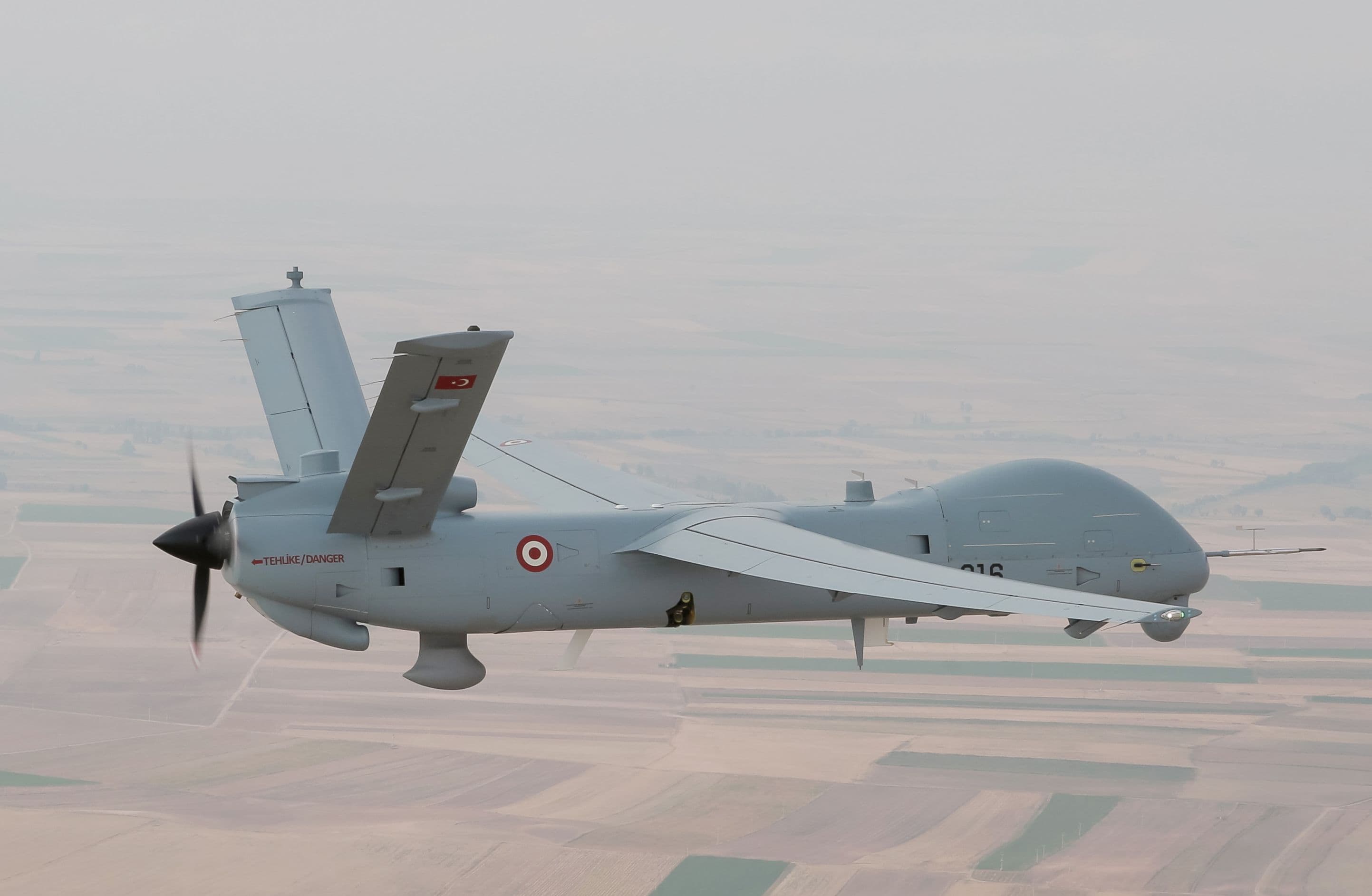
TAI Anka-S
The TAI Anka-S is Turkey's satellite-controlled medium-altitude, long-endurance UCAV, providing beyond-line-of-sight capability that complements the Bayraktar TB2 with longer endurance, heavier payload, and SATCOM control for operations in Syria, Libya, and northern Iraq.
The TB2's Bigger, Quieter Sibling
Everyone talks about the Bayraktar TB2. It has the combat footage, the folk songs, the 35-plus export customers. But the TB2 has a limitation that rarely comes up in those conversations: it operates on line-of-sight data links. That caps its operational radius at roughly 150 to 300 kilometres from the ground control station, depending on configuration. For border operations, that's fine. For conducting strikes deep in Syria, across the Mediterranean into Libya, or over the mountains of northern Iraq from a command centre back in Turkey, it's not enough.
So there's the Anka-S. Built by Turkish Aerospace Industries (TAI, also known as TUSAS), it's a satellite-controlled MALE drone that can be flown from anywhere in Turkey via SATCOM relay, regardless of how far away the operating area is. It carries the same class of weapons as the TB2, stays airborne for 24 to 30 hours, and has a payload capacity of 350 kg compared to the TB2's 150 kg total. The Anka-S doesn't get YouTube compilations or patriotic music. It does get the missions that the TB2 physically can't reach.
How It Got Here
The Anka programme started in 2004 as a Turkish Air Force requirement for a domestically built MALE UAV. The underlying motivation was reducing Turkey's dependence on imported systems, specifically the Israeli Heron drones the Turkish military had previously operated. TAI got the contract.
The first prototype flew on 30 December 2010, a 14-minute test flight that validated the basic airframe and controls. This was the Anka-A, a technology demonstrator. The Anka-B followed with refinements to avionics, sensors, and flight controls, serving as the bridge between the demonstrator and the production model.
The Anka-S, the serial production configuration with the critical SATCOM antenna, started reaching the Turkish Air Force in early 2017. That's a 13-year development cycle from programme launch to operational service, which looks slow compared to Baykar's rapid TB2 development, but TAI was attempting something more ambitious: a heavier airframe, satellite communications integration, a nationally developed flight control computer. More ambition means more time. The result was a more capable platform.
The Aircraft
The Anka-S is substantially bigger than a TB2. Wingspan is 17.5 metres (the TB2 spans 12 metres). Fuselage runs 8 metres. Maximum takeoff weight is about 1,700 kg, roughly two and a half times the TB2's 700 kg. All that extra size buys more fuel, a heavier sensor package, more weapons, and the SATCOM system.
Construction is composite materials in a conventional twin-boom, high-wing configuration. Nothing exotic about the layout; it's a proven MALE drone architecture.
Power comes from a Thielert Centurion 2.0S, a diesel engine adapted from a Mercedes-Benz automotive block to run on JP-8, the standard military jet fuel. That's a practical choice. JP-8 is available at any NATO airfield, so logistics for deployed operations get simpler. Diesel engines also burn fuel more efficiently than petrol alternatives, which helps with the Anka-S's endurance numbers.
The engine choice carries a political risk, though. It's German-made, and Germany has a track record of restricting defence component exports when political winds shift. Turkey has been working on indigenous diesel alternatives, but the timeline for fully replacing the Centurion in production isn't clear.
SATCOM: Why This Drone Exists
The dorsal fairing on top of the fuselage is a ViaSat VR-18C high-power satellite communications antenna. This is the Anka-S's reason for being. Without it, you've just got a bigger, more expensive alternative to the TB2. With it, you've got a drone that can be controlled from a facility in Ankara while flying over Idlib, Tripoli, or the Qandil Mountains.
Beyond-line-of-sight control via military communication satellites means the ground control station doesn't need to be anywhere near the operating area. The TB2 needs its control station within 150 to 300 km. The Anka-S has a cited operational range of 2,500 km, limited by fuel rather than data link reach.
For a country running simultaneous military operations in Syria, Iraq, and at one point Libya, the ability to control all those drone missions from central facilities rather than forward-deploying vulnerable ground stations to each theatre is a genuinely significant operational advantage. Less logistics, better security, easier command and control.
The downside: SATCOM depends on satellite access. Turkey leases capacity on commercial and military satellites. In a high-intensity conflict against a peer adversary, those satellite links could be jammed or degraded. The Anka-S doesn't have enough autonomous mission capability to keep going if the SATCOM link drops. That's a known vulnerability, and one that matters more the higher you go up the escalation ladder.
Sensors and Weapons
The sensor fit centres on ASELSAN's CATS (Common Aperture Targeting System) or equivalent EO/IR turrets for day and night surveillance, infrared imaging, laser designation, and rangefinding. Broadly comparable to what the TB2 carries, but the Anka-S can take heavier, longer-range sensor options because it has the payload margin. A synthetic aperture radar option gives it all-weather surveillance capability that the TB2 lacks in its standard configuration.
Weapons are from Roketsan's lineup:
- MAM-L: The same 22 kg semi-active laser-guided bomb the TB2 carries. Effective against armour, vehicles, light structures.
- MAM-C: A 6.5 kg lightweight precision munition for softer targets.
- Cirit: 70mm laser-guided rocket for anti-armour work.
- Bozok: Laser-guided rocket system.
- L-UMTAS: Long-range anti-tank missile, the heavier option for armoured targets.
The 350 kg payload capacity means a fully armed Anka-S carries a considerably more diverse weapons mix than the TB2 while keeping its sensors online. That flexibility matters for longer missions where the target type isn't known in advance.
Syria: Spring Shield
The Anka-S's most intensive combat came during Operation Spring Shield in March 2020. On 27 February, a Syrian government airstrike in Idlib province killed 33 Turkish soldiers. Turkey's response was a coordinated drone offensive using both Anka-S and TB2 platforms.
The division of labour was illustrative. TB2s worked from ground control stations near the border, engaging targets within their line-of-sight range. The Anka-S, controlled via satellite, operated deeper into Syrian territory beyond TB2 reach. Turkish sources claimed the destruction of hundreds of Syrian military assets during the operation: tanks, armoured vehicles, artillery, air defence systems. The Anka-S reportedly handled the deeper targets while TB2s concentrated on the front-line zone.
On 1 March 2020, an Anka-S was shot down by an air defence system near Saraqib in Idlib. That confirmed what everyone already knew: like the TB2, the Anka-S can't survive against active air defences. Its larger airframe and that dorsal SATCOM antenna probably make it more detectable on radar than the smaller TB2, which isn't exactly reassuring.
Libya and Iraq
Turkey deployed drones to Libya in support of the Government of National Accord during the civil war. The TB2 was the primary platform, but Anka-S aircraft were reportedly involved too, using SATCOM to operate across the Mediterranean from control stations in Turkey. According to a UN Security Council report, a TAI Anka drone was shot down by Libyan National Army forces near Misrata. A second was reported lost near Tarhouna on 23 May 2020. More confirmation that ground-based air defences are the consistent vulnerability.
Northern Iraq has been the Anka-S's steadiest operational theatre. Turkey runs continuous drone operations against PKK positions in the mountainous terrain of northern Iraq. The SATCOM capability and long endurance are well suited to this: sustained surveillance over remote, rugged terrain at ranges that often exceed TB2 reach from Turkish territory.
Anka-S vs. TB2: The Honest Comparison
These two platforms get compared constantly, and the comparison is instructive because they're optimised for different things.
Range and control is the Anka-S's decisive edge. SATCOM versus line-of-sight is a qualitative difference, not just a quantitative one. For expeditionary operations far from Turkey's borders, the Anka-S is the only option.
Endurance is roughly comparable: 24 to 30 hours for the Anka-S versus 27 hours for the TB2. The diesel engine's fuel efficiency compensates for the Anka-S's higher weight.
Payload is where the scale difference shows. The Anka-S carries 350 kg; the TB2's total payload capacity is 150 kg (of which about 55 kg is allocated to the optronic system, leaving roughly 95 kg for weapons). That translates to heavier sensors, more weapons, and greater mission flexibility for the Anka-S.
Cost is where the TB2 wins. The SATCOM system, larger airframe, and diesel engine make the Anka-S substantially more expensive. Exact figures aren't public, but estimates put it at several times the TB2's unit cost. That price difference is the main reason the TB2 has 35-plus export customers while the Anka-S has a handful.
Exports: Tunisia and Malaysia are confirmed Anka-S customers. Malaysia announced its acquisition in 2025 for maritime surveillance in the South China Sea. A small number of additional customers are in various stages of negotiation. For operators who specifically need SATCOM and heavier payload, the Anka-S makes sense. For everyone else, the TB2 is the easier and cheaper answer.
The Broader Anka Family
The Anka-S sits in the middle of a growing TAI product line.
The Aksungur is the next step up: a larger, twin-engine MALE drone with higher payload and longer endurance, plus maritime patrol capability. It's already in Turkish military service.
The Anka-3 (ANKA III) is the ambitious one, a stealthy flying-wing UCAV that represents a generational jump from the conventional Anka-S configuration. First flight was in 2023, first live weapons firing in 2024. TAI is going after the stealth drone segment alongside Baykar's Kizilelma.
The Goksungur targets the HALE (High Altitude, Long Endurance) bracket, the territory currently dominated by American systems like the RQ-4 Global Hawk.
The Anka-S was the foundation. The programme that proved TAI could build a MALE drone with SATCOM control and actually deliver it to the Turkish Air Force. Everything that followed builds on that engineering experience and those operational lessons.
Where It Falls Short
Survivability is effectively zero against modern air defences. The losses in Syria and Libya proved that in practice. The larger airframe (17.5 m wingspan) and dorsal SATCOM antenna give it a radar cross-section meaningfully larger than the TB2 or comparable drones like the Hermes 900. The Anka-3 flying wing addresses this with a low-observable design, but the conventional Anka-S will remain the more detectable aircraft for its entire service life.
Speed is MALE-class standard: 217 km/h maximum, 204 km/h cruise. Too slow to evade competent air defences.
Maintenance complexity exceeds the TB2's. The SATCOM system, diesel engine, and larger airframe all require more support infrastructure. For export customers without deep technical capability, this affects how many hours the aircraft actually flies versus sitting in the hangar.
And the engine supply chain is a recurring concern. German export policy could disrupt Centurion engine availability at any time. Turkey's indigenous alternatives aren't ready yet.
Why It Matters
The Anka-S matters for two reasons that go beyond the aircraft itself.
First, it gives Turkey beyond-line-of-sight drone capability. For a country running active military operations across multiple theatres simultaneously, controlling drones via satellite from central command facilities is not a nice-to-have. It's an operational requirement. The TB2 can't do it. The Anka-S can.
Second, the programme established TAI as a credible MALE drone manufacturer. Turkey's drone industry now has two competitive manufacturers with complementary product lines: Baykar for the lighter, cheaper, high-volume market, TAI for the heavier, SATCOM-capable segment. That gives Turkey industrial redundancy and gives export customers choices at different capability and price points.
The Anka-S will eventually be overtaken by newer platforms, the Aksungur, the Anka-3, whatever comes after them. But the satellite-controlled MALE concept it proved for Turkey's military isn't going away. Any nation doing expeditionary drone operations beyond its own borders needs BLOS capability. The Anka-S demonstrated Turkey could deliver it, and that proof shapes everything built on top of it.
Sponsored
Place your ad hereSpecifications
| Wingspan | 17.5 m (57.4 ft) |
| Length | 8 m |
| Max Takeoff Weight | 1,700 kg |
| Payload | 350 kg |
| Max Altitude | 9,144 m (30,000 ft) |
| Endurance | 24–30 hours |
| Max Speed | 217 km/h (134 mph) |
| Cruise Speed | 204 km/h |
| Range | 2,500 km (with SATCOM) |
| Engine | Thielert Centurion 2.0S (diesel/JP-8) |
| Armament | MAM-L, MAM-C, Cirit rockets, Bozok LGR, L-UMTAS |
| Propulsion | Diesel (pusher) |
| SATCOM | ViaSat VR-18C airborne antenna |