Drones of War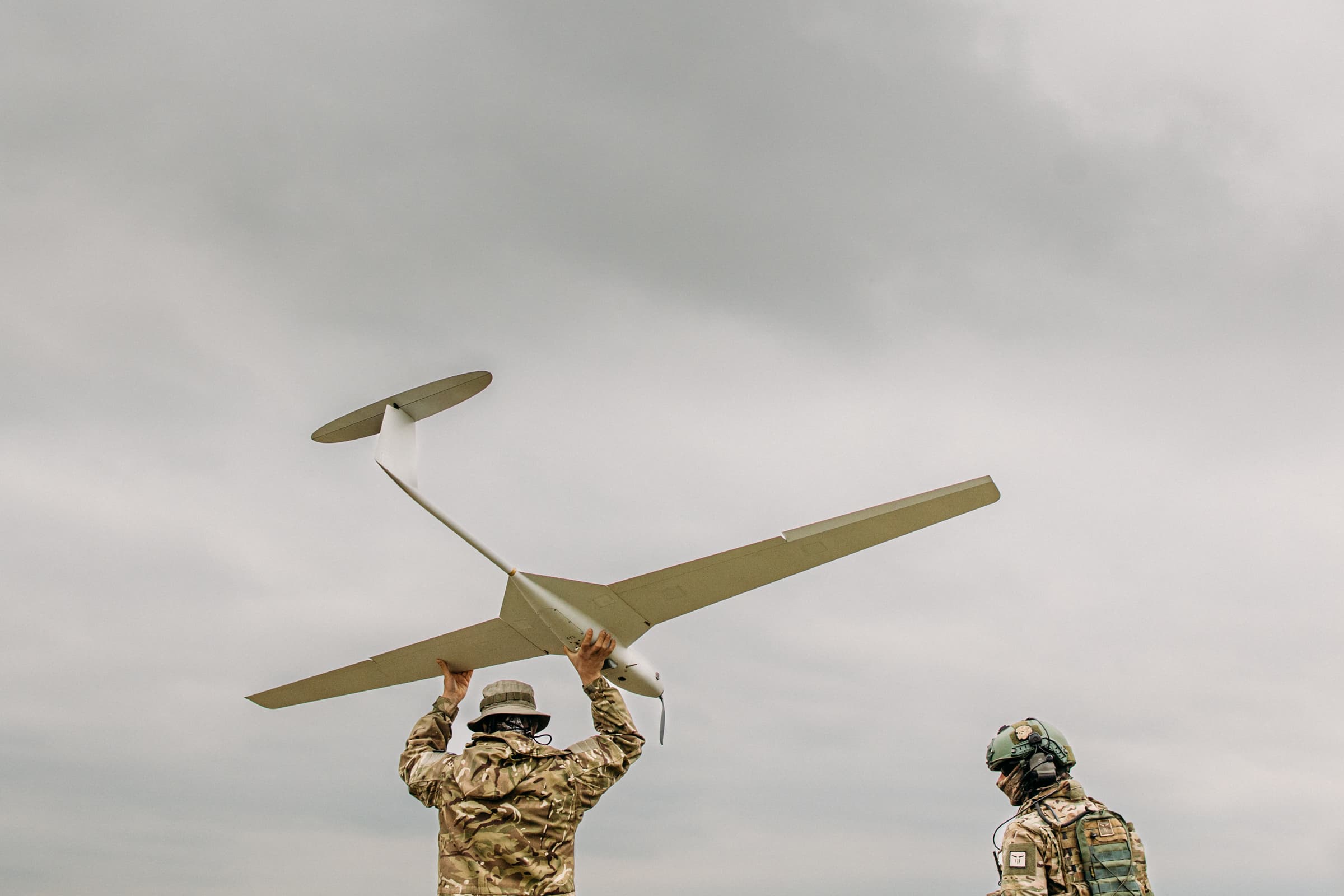
Punisher
The Punisher is a small Ukrainian-made electric drone that flew over 60 combat missions in the first weeks of Russia's invasion, proving that cheap, reusable unmanned aircraft could deliver precision strikes before the age of FPV drones transformed the war.
Sixty Missions Before Anyone Noticed
Before FPV kamikaze drones took over the narrative, before the Bayraktar TB2 footage went viral on social media, there was a small electric drone called the Punisher quietly hitting Russian logistics targets night after night in the opening weeks of the 2022 invasion.
UA Dynamics, the Ukrainian startup behind the aircraft, claimed over 60 successful sorties in that early period. Ammunition depots, fuel stores, logistics convoys stalled on roads north of Kyiv, command posts identifiable by their antenna farms. Small targets, but the right targets at the right time. Those numbers are hard to verify independently, and I'd treat the exact figure with some caution. But the Punisher's contribution was real enough to draw attention from Ukraine's military leadership and international media at a point in the war when anything that actually worked was worth its weight in gold.
What made it interesting was the philosophy. The Punisher isn't a kamikaze drone. It drops its bombs and flies home. In a war that would soon be defined by expendable weapons, cheap FPV quads thrown at targets by the thousand, this thing was designed to survive, get rearmed, and go out again. At roughly $196,000 for a complete system (two aircraft, ground station, and trainer), it needed to come back.
The Aircraft
Strip away the military context and the Punisher looks a lot like what it is: a scaled-up model aircraft fitted with a bomb release. Fixed-wing, electric powered, composite airframe, 2.3 metres of wingspan, about 7.5 kg maximum takeoff weight. The electric motor makes it nearly silent at operational altitude, which for a drone designed to fly behind enemy lines at night is the whole point.
The operational concept is simple. Launch by hand or from a small rail. The drone flies a pre-programmed GPS route to the target, drops up to three small bombs (about 2.5 kg total payload), and returns autonomously to a recovery point. After launch, the operator is out of the loop. No joystick flying, no video feed, no datalink. The aircraft executes its mission and comes back on GPS.
That autonomy cuts both ways. On the plus side, the Punisher emits no control signals while in flight, which means Russian electronic warfare systems have nothing to detect or jam. Radio-controlled drones are vulnerable to exactly that kind of interference, and Russian EW capability has been one of the defining features of this war. A GPS-autonomous drone sidesteps the problem entirely.
The downside is that you can't redirect it. If the target moves between the reconnaissance pass and the strike, the bombs land on empty ground. You set coordinates, launch, and hope.
Range is about 45 km, endurance 2 to 3 hours, and typical operating altitude sits around 400 metres. That keeps it below the engagement envelope of medium-range air defences while high enough for the bombs to fall with reasonable accuracy.
Small Bombs and Why They Worked
Three munitions totalling about 2.5 kg, dropped sequentially from an internal bay. GPS-guided or simple ballistic release from a known altitude and speed.
Less than a kilogram per bomb won't scratch a tank. Against a hardened bunker, it's nothing. But the Punisher was never meant for those targets. Its target set was soft logistics: fuel trucks, parked vehicles, ammunition caches, generators, comms equipment, supply dumps. Drop a small bomb accurately onto a fuel truck and the secondary explosion does the real damage. Three bombs across a vehicle park or ammo cache can produce results wildly out of proportion to their size.
UA Dynamics reportedly used a companion ISR drone called the Spectre to find and confirm targets before programming the Punisher's mission. The Spectre flies first, locates the target, the operator sets the coordinates, and the Punisher follows. After the strike, the Spectre can fly back to assess damage, and if the first sortie didn't finish the job, another Punisher can be sent.
February 2022: The Right Drone at the Right Moment
The Punisher's window was February and March 2022. Maximum chaos. Russian forces advancing on multiple axes, Kyiv partially encircled, Ukraine's ability to reach behind Russian lines severely limited. The TB2s were delivering spectacular results but were few in number and getting picked off by Russian air defences. Fixed-wing combat aircraft were devoted to air defence. Ukraine needed something that could slip through and strike logistics.
The Punisher did that. Imperfectly, in small numbers, but it did it. Silent flight, tiny radar signature, no radio emissions to give it away, autonomous navigation that Russian EW couldn't jam. And because it was reusable, a small fleet could generate a steady rhythm of sorties. If the 60-mission claim is anywhere close to accurate, that's a remarkable output for a startup product in wartime conditions. Each successful strike against a fuel dump or ammo cache compounded the supply problems that ultimately stalled the Russian drive on Kyiv.
Why the FPV Drone Ate Its Lunch
By mid-2022 the Punisher had largely disappeared from the war coverage. The FPV revolution had arrived, and it changed the calculus entirely.
An FPV drone costs maybe $400. You fly it into the target and it's gone. No recovery, no landing zone to secure, no risk of a $100,000 asset being damaged on touchdown in a combat zone. The math is brutal: for the price of one Punisher, you can field 500 FPV drones, each carrying a warhead that can kill an armoured vehicle. The Punisher's reusable design is elegant in theory. In practice, every recovery in a war zone is a liability, and the economics of expendability are hard to argue with.
The payload gap sealed it. Two and a half kilograms of bombs works against soft targets. But as the war shifted to positional fighting, the primary target set became armoured vehicles, fortified positions, and individual fighting positions. An FPV drone carrying a PG-7VL warhead can kill a tank. The Punisher can't get close to that kind of effect.
And FPV drones offer real-time pilot control: the operator sees what the drone sees and can hit moving targets, adjust on the fly, engage targets of opportunity. A pre-programmed autonomous drone can't do any of that. The flexibility gap is enormous.
None of this means the Punisher became useless. For hitting fixed soft targets at ranges beyond FPV capability, it still has genuine advantages: silent approach, EW resistance, reusability for sustained campaigns against logistics networks. But the centre of gravity in Ukrainian drone warfare moved decisively toward expendable platforms, and the Punisher ended up on the margins.
Who Operates It
Ukraine remains the only confirmed operator as of early 2026. UA Dynamics has shown the platform at international defence exhibitions and indicated interest in exports. Several countries have reportedly expressed interest, but no confirmed foreign sales.
What It Proved
The Punisher matters less for what it became than for what it showed at a critical moment. A startup's electric drone, flying autonomously behind the lines of a major military power, hitting logistics targets night after night, and coming back to do it again. In the opening weeks of the largest European ground war in decades.
It demonstrated that cheap, reusable, autonomous light attack drones can contribute to a conventional war. It showed that silent electric propulsion paired with GPS autonomy can defeat sophisticated EW. And it previewed the model, small drones systematically attacking logistics, that FPV drones would later scale up by orders of magnitude.
The Punisher was a bridge between the old world of military drones and the new one where every platoon has its own strike capability. It got there first, did the job when it counted, and then the revolution it helped kick off left it behind.
Sponsored
Place your ad hereSpecifications
| Wingspan | 2.3 m |
| Length | 1.4 m (estimated) |
| Max Takeoff Weight | 7.5 kg |
| Payload | 3 bombs (up to 2.5 kg total) |
| Max Speed | 120 km/h |
| Cruise Speed | 60 km/h |
| Endurance | 2-3 hours |
| Range | 45 km |
| Ceiling | 400 m (operational) |
| Propulsion | Electric (battery-powered) |
| Guidance | GPS autonomous + waypoint navigation |
| Launch | Hand-launched or rail |