Drones of War
Samad-3
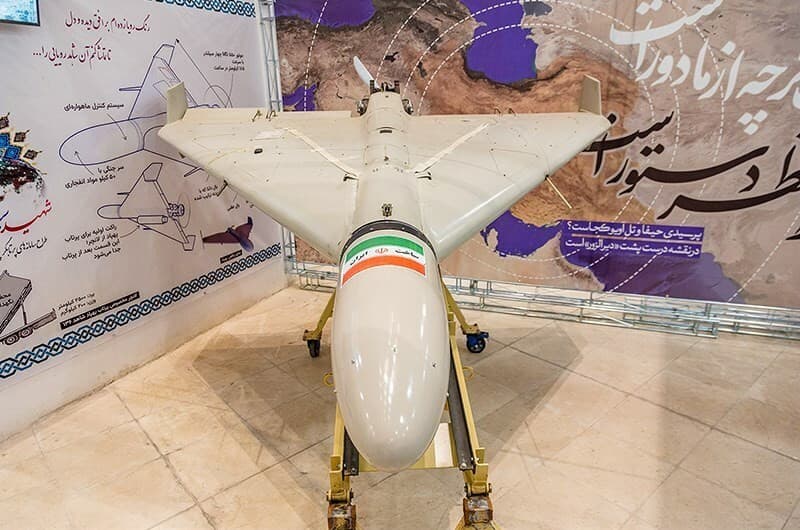
The Samad-3 is a long-range one-way attack drone operated by Houthi forces in Yemen, most infamously used in the July 2024 strike on Tel Aviv and linked to the devastating 2019 Abqaiq-Khurais attacks on Saudi oil infrastructure.
A $10,000 Drone vs. a $3 Million Interceptor
Here's the number that tells you everything about the Samad-3: Saudi Arabia spends somewhere between $2 million and $4 million each time it fires a Patriot interceptor at one. The drone itself costs maybe $10,000 to build. Repeat that equation a few hundred times and you start to understand why this crude, slow, commercially built weapon has become one of the more consequential military systems of the past decade. Not because of what it can do on any single mission, but because of what it forces the other side to spend.
The Samad-3 is a long-range one-way attack drone operated by Houthi forces (formally Ansar Allah) out of Yemen. It's built from foam composites, fibreglass, and a model aircraft engine you could buy online. It navigates by GPS and inertial guidance, which gives it the accuracy to hit a city block but not a specific building. And yet it has struck Tel Aviv, been claimed in the attacks that knocked out half of Saudi Arabia's oil production, and forced some of the most expensive air defence networks on the planet into a cost spiral they can't sustain.
The Tel Aviv Strike
At 3:12 a.m. on 19 July 2024, a small unmanned aircraft crossed the Israeli coastline from the Mediterranean, flew over central Tel Aviv without being intercepted, and detonated at the intersection of Ben Yehuda Street and Shalom Aleichem Street, near the US Embassy branch office. One man was killed. Ten others were injured.
The Houthis claimed it within hours, calling the drone "Yafa." Western analysts identified the airframe as a Samad-3, possibly with minor modifications. The IDF later acknowledged something embarrassing: they had detected and tracked the drone the entire time. No interception order was given. The official explanation was "human error."
Think about that for a moment. Israel operates Iron Dome, David's Sling, Arrow, and a dense surveillance radar network. A drone assembled in a Yemeni workshop, flying at maybe 200 km/h, got through because someone in the decision chain didn't pull the trigger. The technology worked. The process didn't. That's a lesson that should keep defence planners up at night, because you can buy better radar but you can't always fix the human links in the chain.
Where It Comes From (and Who's Really Behind It)
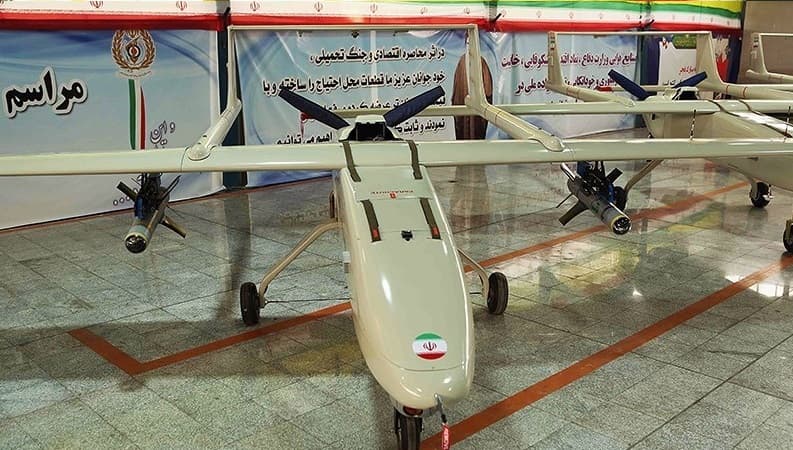
The Samad family is manufactured in Houthi-controlled territory, but let's not be coy about this: the design is Iranian. Components recovered from Samad airframes overlap heavily with those found in Iranian Ababil and Qasef-series drones. A UN Panel of Experts report flagged shared manufacturing signatures across the family. Western intelligence agencies broadly agree that Iran provided design assistance, components, and probably complete kits for local assembly.
The name itself comes from Saleh Ali al-Sammad, a senior Houthi political leader killed in a Saudi-led coalition airstrike in April 2018. The drone family was unveiled later that year.
Tehran gets to impose costs on Saudi Arabia, disrupt global energy markets, and threaten Israeli territory without directly engaging any of these adversaries. The deniability is paper-thin, but it has held for years. No country has launched direct military retaliation against Iran over these strikes, which tells you the deniability is working well enough for its purpose.
How It's Built
The Samad-3 is not an impressive piece of engineering. That's the point.
The airframe spans about 4.5 metres with a length of around 2.8 metres. Construction is foam-core composites and fibreglass, closer to what a serious model aircraft builder would use than anything resembling aerospace manufacturing. There's a V-shaped tail, a narrow fuselage, and a rear-mounted pusher propeller. The whole thing looks like it was built in a garage. Some of them probably were.
The engine is where it gets interesting, or maybe depressing depending on your perspective. The pusher motor is typically either a German 3W 110i B2 two-stroke or a Chinese DLE 170. Both are commercially available model aircraft engines, putting out roughly 10 to 15 horsepower. You could order one online for a few hundred dollars. The pusher configuration keeps the propeller noise and heat signature behind the airframe, which helps a little with detection, though calling this "stealth" would be generous.
What separates the Samad-3 from the earlier Samad-1 and Samad-2 variants is a conformal fuel tank mounted on the upper fuselage. That extra fuel is the whole story. It pushes the operational range out to roughly 1,500 to 1,800 kilometres depending on payload and weather. Academic modelling by Voskuijl et al. in Science & Global Security confirmed that ranges exceeding 1,800 km are achievable under favourable conditions. That puts Riyadh, the Persian Gulf coast, and (with the right routing) Tel Aviv within reach from Houthi-controlled Yemen.
Navigation is INS plus GPS. No terrain matching, no scene-matching terminal guidance, nothing sophisticated. The accuracy is poor by military standards. Good enough to hit a large oil processing facility or a city neighbourhood. Not good enough for a specific building. For the Houthis' purposes, that has been sufficient.
The warhead is estimated at about 18 kg of explosives mixed with ball bearings, contact-detonated on impact. Enough to cause serious damage to soft targets and unprotected infrastructure. Not enough to crack a hardened bunker. The Tel Aviv variant reportedly carried even less, under 10 kg, having traded warhead weight for additional fuel to extend range.
Abqaiq-Khurais: The Big One
On 14 September 2019, a combined drone and cruise missile attack struck the Abqaiq and Khurais oil processing facilities operated by Saudi Aramco in eastern Saudi Arabia. The result: roughly 5.7 million barrels per day of crude production knocked offline. That was about half of Saudi output, around 5 percent of global supply. Brent crude futures spiked nearly 20 percent at the open, the largest single-day jump on record for Brent, before settling back around 10 to 15 percent.
Houthi military spokesman Yahya Sarea claimed the attacks, saying the operation used Samad-3 drones alongside Quds-series cruise missiles and Qasef drones launched from Yemen. But the attribution is contested, and the debate hasn't been settled.
Saudi officials, backed by the US, France, Germany, and the UK, concluded the attack came from the north and east, not from Yemen to the south. The debris included components consistent with Iranian manufacture. So did the Samad-3s actually hit Abqaiq, or were they part of a diversionary wave? Honest answer: the open-source evidence doesn't resolve this definitively.
What isn't debatable is the strategic effect. One attack, using relatively crude weapons, demonstrated that Gulf energy infrastructure was exposed to this kind of threat. The global oil market reacted immediately. Defence ministries worldwide started scrambling to rethink their counter-drone postures. And the Houthis, whatever their actual role in Abqaiq, proved they had weapons capable of threatening targets across the Arabian Peninsula.
The Broader Combat Record
The two headline strikes get the attention, but the Samad family has been busy well beyond those events.
Against Saudi Arabia, Houthi forces have launched hundreds of drone attacks since 2015, with range and frequency increasing steadily. Samad variants have gone after Abha International Airport, military bases in the southern provinces of Jizan and Najran, and economic targets across the kingdom. Saudi Patriot batteries have intercepted plenty of them. But when you're shooting $3 million missiles at $10,000 drones, "plenty" doesn't solve the underlying maths problem.
The Red Sea campaign from 2023 onward is a different beast. After the Israel-Hamas conflict escalated in October 2023, the Houthis launched sustained drone and missile attacks against commercial shipping in the Red Sea and Gulf of Aden. The primary anti-shipping threats were ballistic missiles and maritime-specific drones, but Samad-series systems featured in broader strikes targeting Israeli territory. The campaign forced a multinational naval coalition response and disrupted one of the world's busiest shipping lanes.
Then there's Abu Dhabi. In January 2022, drones and ballistic missiles hit an ADNOC petroleum storage facility and an area near Abu Dhabi International Airport. Three workers died. The Samad family was reportedly among the systems used. This one mattered because the UAE had partially pulled back from the Yemen coalition and was considered lower-risk than Saudi Arabia. That assumption evaporated overnight. Gulf states across the region reassessed their air defence postures.
Houthi forces have also targeted Eilat in southern Israel repeatedly. Many of these attacks were intercepted by Israeli defences or US naval assets. But the sustained targeting of Israeli territory from Yemen opened a threat axis that Israel simply hadn't had to worry about at that tempo before.
Why the Defences Keep Struggling
I want to be clear about something: the Samad-3 is not sophisticated. It is slow, inaccurate, not stealthy in any real radar-cross-section sense, and carries a modest warhead. By every technical metric, modern air defences should handle it easily. And sometimes they do. But "sometimes" isn't good enough when the attacks keep coming.
The cost problem is the obvious one. A Patriot interceptor at $2 to $4 million per shot against a drone worth maybe $10,000 is arithmetic that favours the attacker every single time.
But there's a detection problem too. The Samad-3 is small, slow, and flies low. Air defence radars designed to track fast-moving ballistic missiles or fighter aircraft can struggle with slow, small targets hugging the ground where clutter degrades radar performance. This isn't a failure in the air defence design. These systems were built for a different kind of threat. The mismatch is the problem.
And then there's the human factor, which the Tel Aviv strike put on display. Israel's layered defences tracked the drone but didn't engage it. Counter-drone defence turns out to be as much an organisational and doctrinal challenge as a technological one. You can have the sensors and the interceptors and still fail if the decision cycle doesn't work.
The Family Tree
The Samad-3 didn't appear from nowhere. The progression matters because it shows how Iran's proxy drone model works in practice: start simple, learn from operational use, and iterate.
The Samad-1 was basically a surveillance platform. Limited range, a few hundred kilometres at best, confined to the Yemen battlespace. Probably served double duty as a training platform for Houthi operators.
The Samad-2 stepped up to the 1,000 to 1,200 km range bracket, which was enough to reach Saudi cities and military installations. It shares the V-tail configuration that carries through to the Samad-3. This is the variant that first demonstrated the Houthis could hit targets inside Saudi Arabia.
The Samad-3 added the conformal fuel tank and pushed range to 1,500 to 1,800 km. This is the one that reached Tel Aviv, that featured in the Abqaiq claims, and that represents the current high-water mark for Houthi long-range capability.
The Houthis have talked about a Samad-4 and additional variants with better range, payload, and guidance. The "Yafa" designation from the Tel Aviv attack might be something beyond the Samad-3, though most Western analysts assess it as a Samad-3 with minor tweaks rather than a genuinely new design.
What It Can't Do
It's worth being honest about the limitations, because there's a tendency in threat reporting to make these systems sound more capable than they are.
Accuracy is the biggest constraint. INS/GPS gets you city-scale targeting. That's fine for a sprawling oil facility. It's useless for precision strike against anything smaller or harder.
The airframe won't survive much. Severe weather, any kind of battle damage, or an alert air defence system that's actually looking for it. The commercial-grade construction that keeps costs down also means these things are fragile.
GPS jamming and spoofing can defeat the navigation. Most modern militaries have that capability. The Samad-3 has no known anti-jam features or backup terminal guidance.
Each one is a single-use munition. Unlike a reusable combat drone, every Samad-3 gets expended on its one and only mission. The strategic calculus only works if you can keep producing them cheaply and in volume.
And the speed, 150 to 250 km/h in cruise, is a real vulnerability. Any modern fighter or properly cued air defence system can engage at those speeds without breaking a sweat. The drone's survival depends on finding gaps in coverage, flying low enough to exploit terrain masking, and hoping the radars are pointing at faster-moving threats. That gamble doesn't always pay off.
What the Samad-3 Actually Proves
The Samad-3 matters less for what it is than for what it demonstrates about where warfare is heading.
Before the Houthi drone programme, hitting a target 1,500 km away required cruise missiles, manned aircraft, or ballistic missiles. All of those need serious industrial capacity and state-level resources. The Samad-3 broke that barrier with model aircraft engines and commercial GPS. A non-state militia now has strategic reach.
It also validates Iran's approach to proxy warfare. Transfer the drone technology, let the proxies impose costs and absorb the blame, maintain just enough deniability to avoid retaliation. It's been working for years.
And then there's the broader proliferation pattern. Similar technology has gone to Hezbollah in Lebanon, to Shia militias in Iraq, and potentially to other groups. Simple airframes, cheap engines, basic guidance. The template is easy to copy and hard to counter.
For defence planners in the Gulf, Israel, and the US, the Samad-3 isn't the ceiling. It's the floor. The next generation will be faster, more accurate, possibly carrying better terminal guidance, and manufactured in larger numbers. Directed energy weapons, electronic warfare, and cheap interceptor drones are all part of the answer, but none of them are fielded at the scale needed yet. Until they are, the maths continues to favour the attacker.
Sponsored
Place your ad hereSpecifications
| Wingspan | 4.5 m |
| Length | 2.8 m |
| Height | ~1.5 m (estimated) |
| Weight | ~200 kg (estimated with fuel) |
| Warhead | ~18 kg explosive + ball bearings |
| Range | 1,500–1,800 km |
| Speed | ~150–250 km/h (cruise, estimated) |
| Ceiling | 8,000 m |
| Endurance | ~5 hours |
| Engine | 3W 110i B2 or DLE 170 pusher engine |
| Guidance | INS + GPS |
| Cost | Low (estimated sub-$10,000) |