Drones of War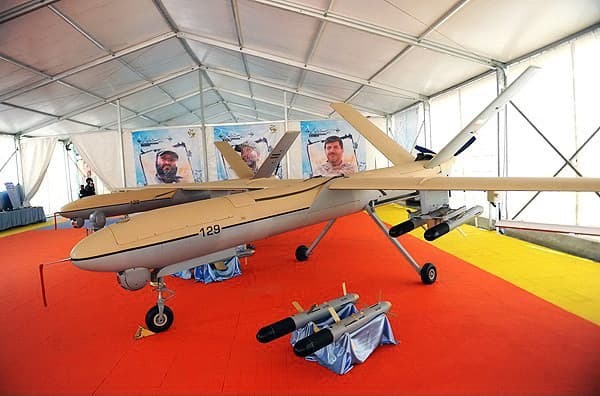
Shahed-129
The Shahed-129 is Iran's first domestically produced medium-altitude, long-endurance armed UAV, deployed by the IRGC in Syria and Iraq since 2014 and shot down twice by US F-15E Strike Eagles near al-Tanf in 2017.
Two Shootdowns That Told the Whole Story
On 8 June 2017, a US F-15E Strike Eagle destroyed an armed Iranian drone near the al-Tanf garrison in southeastern Syria. Twelve days later, on June 20th, the same thing happened again. Both drones were Shahed-129s, Iran's flagship medium-altitude, long-endurance (MALE) platform, and both had been advancing toward coalition positions where American and British special operations forces were training Syrian opposition fighters.
Those two shootdowns tell you almost everything you need to know about the Shahed-129: it's capable enough to worry people, and defenceless enough to die the instant a real air force decides to swat it. A single fighter aircraft, on two separate occasions, destroyed what Iran had spent years developing. No electronic countermeasures, no evasive manoeuvring, no survivability features of any kind. Just an easy kill.
And yet. The Shahed-129 still matters, because Iran didn't build it to fight the US Air Force. They built it to do exactly what it did over Syria and Iraq between 2014 and 2017: fly persistent surveillance missions, drop small guided munitions on opposition forces who had no air defences whatsoever, and prove to the world that Iran could field an armed MALE drone in combat. Before those flights over Syria, only a handful of countries had ever conducted armed drone strikes. The Shahed-129 put Iran on that list. The political significance of crossing that threshold outweighs any honest assessment of the airframe's technical limitations.
What It Is
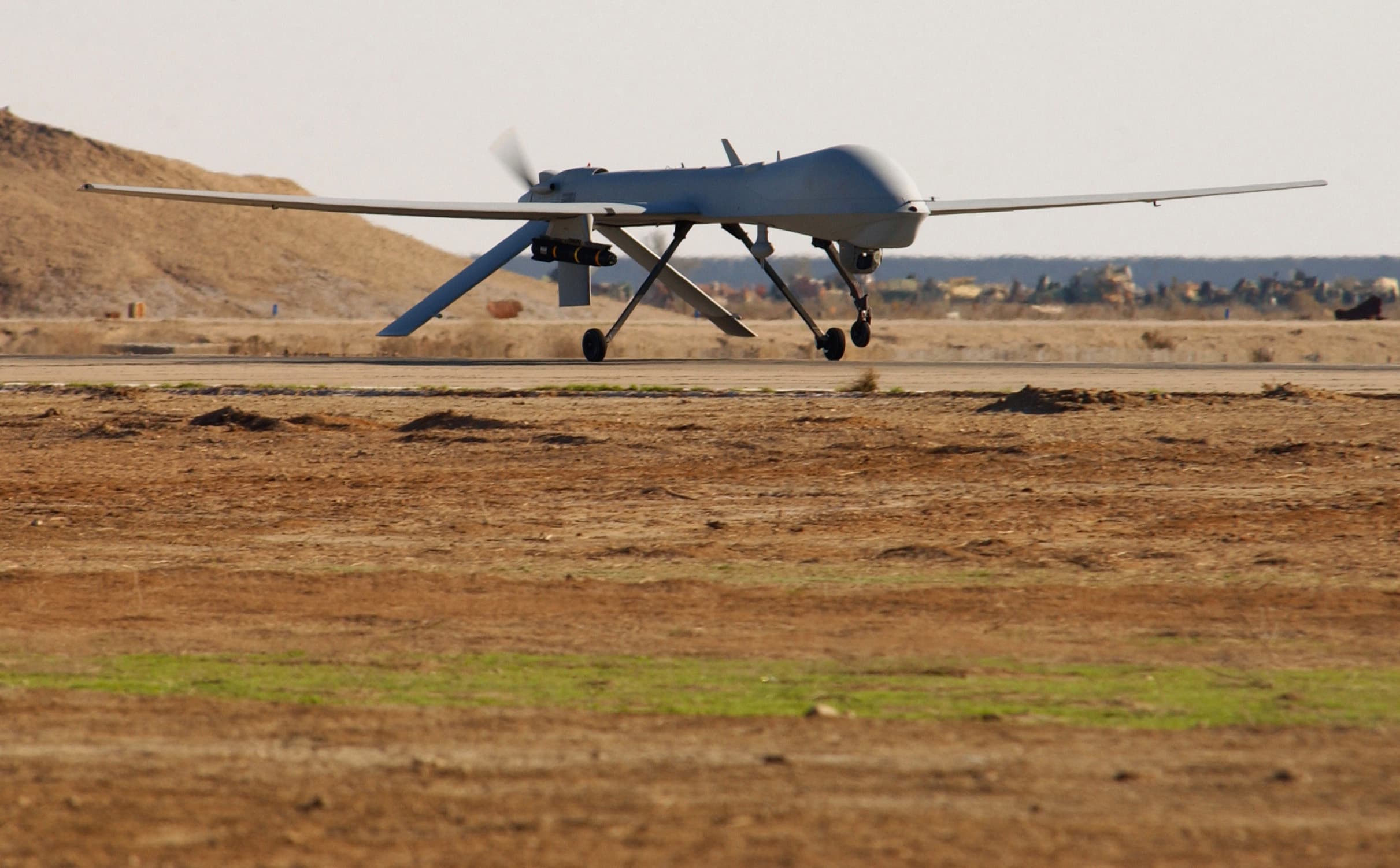
The Shahed-129 (the name means "witness" or "eye-witness" in Farsi) is a conventional MALE UAV built by HESA, the Iran Aircraft Manufacturing Industrial Company, a state-owned enterprise under the Ministry of Defence. Configuration is instantly recognisable if you've ever seen an MQ-1 Predator: high-mounted straight wings, V-tail, retractable tricycle landing gear, chin-mounted sensor turret, rear-mounted pusher propeller. The comparison to the Predator is unavoidable and deliberate. This is Iran's answer to it.
The fuselage runs about 8 metres long with a wingspan of 16 metres, giving it that high-aspect-ratio wing shape you want for efficient cruise and long loiter time. Construction is composite panels over an aluminium alloy structure. The fuselage diameter is fairly narrow, roughly 65 to 75 centimetres.
The first prototype (129-001) flew on 1 March 2012, with a public unveiling in September that year. Iranian officials made ambitious claims about range, endurance, and capability at the time. Some held up. Others didn't.
The Engine Problem
Power comes from a Rotax 914, a four-cylinder turbocharged engine made in Austria that puts out about 75 kW (100 hp) in a pusher configuration. The Rotax 914 is everywhere in the light aviation and drone world, which is both the Shahed-129's advantage and its vulnerability.
The advantage: it's a proven, reliable powerplant with well-understood performance characteristics. The vulnerability: Iran is under international sanctions, and procuring Austrian-made aviation engines isn't supposed to be easy. How Iran has maintained supply is an open question. Procurement through intermediaries, third-country shell companies, the usual sanctions evasion playbook. Some analysts believe later production aircraft may use reverse-engineered or alternative engines, but available intelligence assessments still list the Rotax 914 as the baseline powerplant.
This is a recurring theme across Iranian drone production. The airframes they can build domestically. The engines, sensors, and precision components create supply chain dependencies that sanctions can theoretically exploit, though in practice Iran has been resourceful about working around them.
Sensors and Weapons
The chin-mounted sensor turret carries an electro-optical/infrared (EO/IR) payload for day and night surveillance, plus a laser designator and rangefinder for targeting. Real-time video feeds go back to ground control stations via line-of-sight data link.
I should be direct about the sensor quality: it's significantly below Western and Israeli equivalents. The resolution, the range, the ability to identify and classify targets from altitude are all a step or two behind what you'd find on a Predator or Heron. But "significantly below Western equivalents" doesn't mean useless. Over the Syrian battlefield, where the primary targets were ground vehicles, infantry positions, and fixed installations that weren't exactly hiding, the sensors did the job.
The armed variant carries Sadid-345 precision-guided munitions, a small GPS/laser-guided bomb roughly analogous to Western small-diameter munitions. The aircraft has two twin hardpoints that could theoretically carry four weapons. In practice, you rarely see it carrying more than two, probably due to weight constraints or limited munition availability. Accuracy and reliability of the Sadid-345 appear to be below Western equivalents, though specific data on circular error probable is thin in open sources.
Performance: The Claimed Numbers vs. Reality
Iranian sources claim a maximum altitude of 7,300 metres (about 24,000 feet), endurance of 24 hours, and operational range of 1,700 kilometres. If those numbers are real, it puts the Shahed-129 in roughly the same performance envelope as the original MQ-1 Predator.
The 24-hour figure is the one I'm most sceptical about, at least for the armed configuration. Hanging weapons on the pylons adds weight and drag, both of which eat into fuel efficiency and endurance. The surveillance variant might get close to 24 hours in ideal conditions. The armed version, carrying two Sadid-345s with their associated pylons and rails? I'd expect meaningfully less. But Iran hasn't published separate performance figures for the armed configuration, and independent flight testing data doesn't exist in open sources.
One capability the Shahed-129 clearly lacks: satellite communications for beyond-line-of-sight control. It's a line-of-sight platform, which means the ground control station has to be within data link range. That's a major constraint compared to Western MALE drones that operate via SATCOM and can be controlled from the other side of the planet.
Syria: Where It Actually Fought
The IRGC deployed the Shahed-129 to Syria in May 2014, flying from airfields in government-controlled territory. For the first couple of years, missions were surveillance-only, feeding intelligence to IRGC and allied militia ground operations.
The first confirmed wartime airstrike came in February 2016. That was the milestone event. The specific target hasn't been conclusively identified in open-source reporting, but the strike itself confirmed Iran had gone from building a MALE drone to actually using one in anger. At the time, the club of countries that had conducted armed drone strikes was still very small.
Iranian sources claim over 1,000 "successful operations" in Iraq and Syria combined, a figure that almost certainly blends reconnaissance sorties with armed strikes and should be taken with appropriate caution. What's not in doubt is that the Shahed-129 gave IRGC expeditionary forces something they'd previously lacked: their own organic airborne surveillance and strike capability, independent of the Syrian or Russian air forces.
That independence mattered. The IRGC could fly its own missions on its own timeline, collecting its own intelligence without sharing it through Syrian or Russian channels. For an organisation that operates as much on information control as on firepower, that organic capability was worth having even if the platform itself wasn't world-class.
Iraq: The Parallel Campaign
The Iraq deployment gets less attention but followed a similar pattern. The IRGC flew Shahed-129s over Iraqi territory during the campaign against ISIS, providing surveillance and occasional strike support to Iraqi government forces and Iran-aligned Popular Mobilisation Forces (PMF) militias.
Iraqi airspace was generally less contested than Syria, which reduced the interception risk. The primary mission was ISR over ISIS-held territory, supporting ground advances during the liberation of Tikrit, Fallujah, and Mosul.
The awkward part: Iran was flying these missions in parallel with the US-led coalition's own massive ISR and strike campaign. American MQ-1 Predators and MQ-9 Reapers shared the same airspace with Iranian Shahed-129s. Both were hunting the same enemy, nominally on the same side, but the underlying strategic competition between Iran and the United States for influence over Iraq's security architecture made every deconfliction conversation loaded with subtext.
The al-Tanf Incidents in Detail
Back to those June 2017 shootdowns, because the details matter.
The al-Tanf garrison sits in southeastern Syria near the Iraqi and Jordanian borders. US and British special operations forces were stationed there, training Syrian opposition fighters as part of the anti-ISIS campaign. A deconfliction zone had been established around the base. Pro-Assad forces, including Iran-backed militias, were supposed to stay out.
On June 8th, a Shahed-129 approached the deconfliction zone. US forces assessed it as armed and threatening. An F-15E destroyed it. On June 20th, another Shahed-129 did the same thing. Another F-15E destroyed that one too.
These were the first publicly confirmed instances of the United States shooting down an Iranian drone. The political calculus is interesting: destroying an unmanned platform carries far less escalation risk than shooting down a manned aircraft, but it's still a direct military engagement between two states. Iran barely acknowledged the incidents publicly. The IRGC kept flying other missions in Syria but apparently stopped pushing Shahed-129s into the al-Tanf area.
What the incidents revealed about the aircraft itself was unflattering. The Shahed-129 had absolutely no capacity to survive in anything resembling contested airspace. No electronic warfare suite, no radar warning receiver that could trigger evasive action, no countermeasures of any kind. An F-15E is massive overkill for this target. A far less capable air defence system could have achieved the same result.
The RQ-170 Question
Iran captured an American RQ-170 Sentinel stealth drone in December 2011, and that event looms over every discussion of Iranian drone development. The RQ-170 is a completely different aircraft, a stealthy flying wing, and the Shahed-129 was probably well into development before the capture. The 129's conventional MALE layout shares no obvious design lineage with the Sentinel.
But the broader knowledge gained from tearing apart the RQ-170, GPS navigation architecture, autopilot systems, sensor integration approaches, composite materials, almost certainly helped improve Iran's overall drone engineering competence. The flying-wing design from the RQ-170 fed more directly into the Shahed-191 (Saegheh). The general engineering uplift probably benefited everything HESA was building, including later Shahed-129 production variants.
Where It Fits in Iran's Drone Arsenal
The Shahed-129 occupies a specific niche in what has become one of the world's more diverse drone arsenals. Understanding that niche requires seeing the bigger picture.
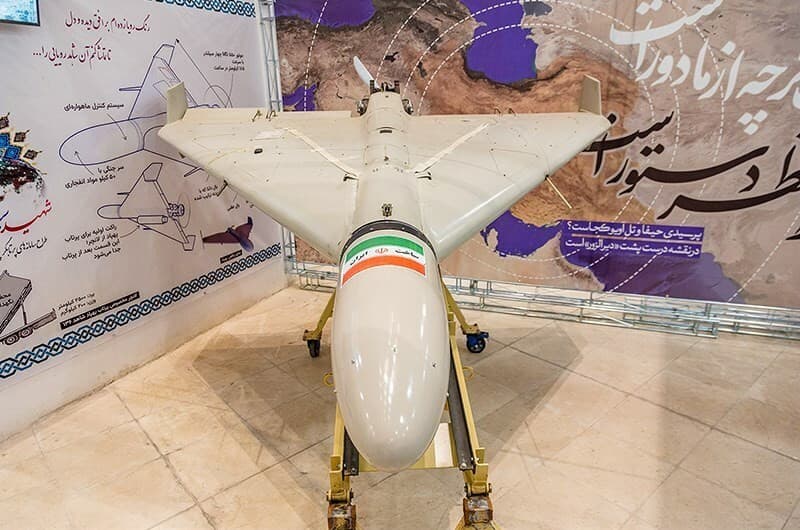
The Shahed-136, the cheap one-way attack drone that became globally infamous through Russia's mass use against Ukrainian infrastructure from 2022 onward, serves a completely different purpose. The 136 is an expendable munition designed for saturation attacks. The 129 is a reusable surveillance and strike platform. Different missions, different economics.
The Shahed-238 is the jet-powered evolution of the 136 concept, with a turbojet engine pushing speeds to 500-600 km/h and multiple seeker options. That's where Iran's expendable-drone programme is heading: faster, harder to intercept.
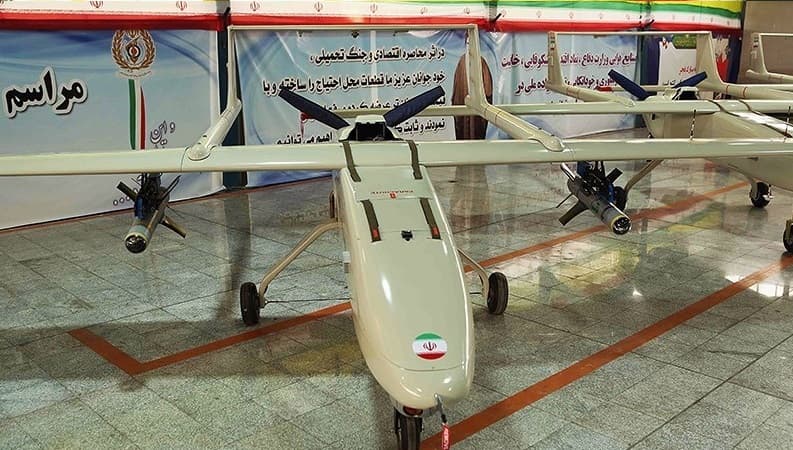
The Mohajer-6 is Iran's other armed MALE drone, smaller than the Shahed-129 but arguably more successful in practice. It's been exported more widely, supplied to Russia for use in Ukraine and to various allied forces across the region.
The Shahed-191 (Saegheh) is the stealthy one, a flying-wing design inspired by the captured RQ-170.
What's happened over the past several years is a visible shift in Iran's priorities. The big MALE platforms like the Shahed-129 continue to serve IRGC needs, but the programme's energy and resources have moved toward the expendable systems, the 136/238 family, where Iran has found a genuine global market and a strategic niche that nobody else was filling at that price point.
Who Flies It
The operator base is narrow, which tells you something about what the Shahed-129 is for.
The IRGC Aerospace Force is the primary operator, deploying it in Syria, Iraq, and potentially over the Persian Gulf for maritime surveillance. There are reports of limited transfer or operational sharing with the Syrian Arab Air Force, though independent Syrian operation hasn't been confirmed. Some reporting links the Shahed-129 or derivatives to Hezbollah and Iraqi Shia militia groups, but those organisations are more commonly associated with smaller, simpler Iranian drone types.
The Shahed-129 isn't a commodity export product. It's a national capability asset that the IRGC keeps close. The Mohajer-6 and Shahed-136 are the export drones. The 129 stays home, or at least stays under IRGC control.
What It Can't Do
Survivability against any real air defence is zero. The al-Tanf shootdowns made that plain. Slow, unstealthy, no electronic countermeasures.
The line-of-sight data link is vulnerable to jamming and interception. In a contested electromagnetic environment, the Shahed-129 would likely lose contact with its operators. It has no satellite backup.
Sensor quality caps what the platform can do for intelligence collection. Against well-concealed or camouflaged targets, the EO/IR payload lacks the resolution and range of Western and Israeli systems.
The Sadid-345 weapons aren't fully reliable by all accounts, and their accuracy constrains the platform's usefulness for precision strikes against small or time-sensitive targets.
And the engine supply chain remains a vulnerability. Sanctions should make Rotax 914 procurement difficult. In practice, Iran has worked around this, but sustaining high-rate production under tightening enforcement is a different challenge.
What It Proved
The Shahed-129 proved that Iran could build and deploy an armed MALE drone in combat. In 2016, fewer than ten countries had done that. The achievement was more political and strategic than technical. The drone itself sits a generation behind Western and Israeli equivalents, and it has been overshadowed by Iran's more innovative expendable systems.
But it gave the IRGC organic airborne strike capability in Syria when they needed it. It demonstrated Iranian technological ambition to regional competitors. It provided the engineering foundation that subsequent programmes built on. And it established Iran as a drone-producing nation with combat-proven systems, a credential that has enabled extensive subsequent exports and technology transfers.
The Shahed-129 isn't the drone that changed the world. That distinction goes to its smaller, cheaper, more numerous descendants in the Shahed-136 family. But it was the drone that proved Iran could build and use these things in a real war, and that proof has had consequences still playing out across multiple theatres.
Sponsored
Place your ad hereSpecifications
| Wingspan | 16 m |
| Length | 8 m |
| Max Takeoff Weight | ~990 kg |
| Payload | 400 kg |
| Max Altitude | 7,300 m (24,000 ft) |
| Endurance | 24 hours |
| Max Speed | 200 km/h |
| Cruise Speed | 150 km/h |
| Range | 1,700 km (operational radius) |
| Engine | Rotax 914 (75 kW / 100 hp) |
| Armament | Sadid-345 PGMs (up to 4 munitions) |
| Propulsion | Piston (pusher) |